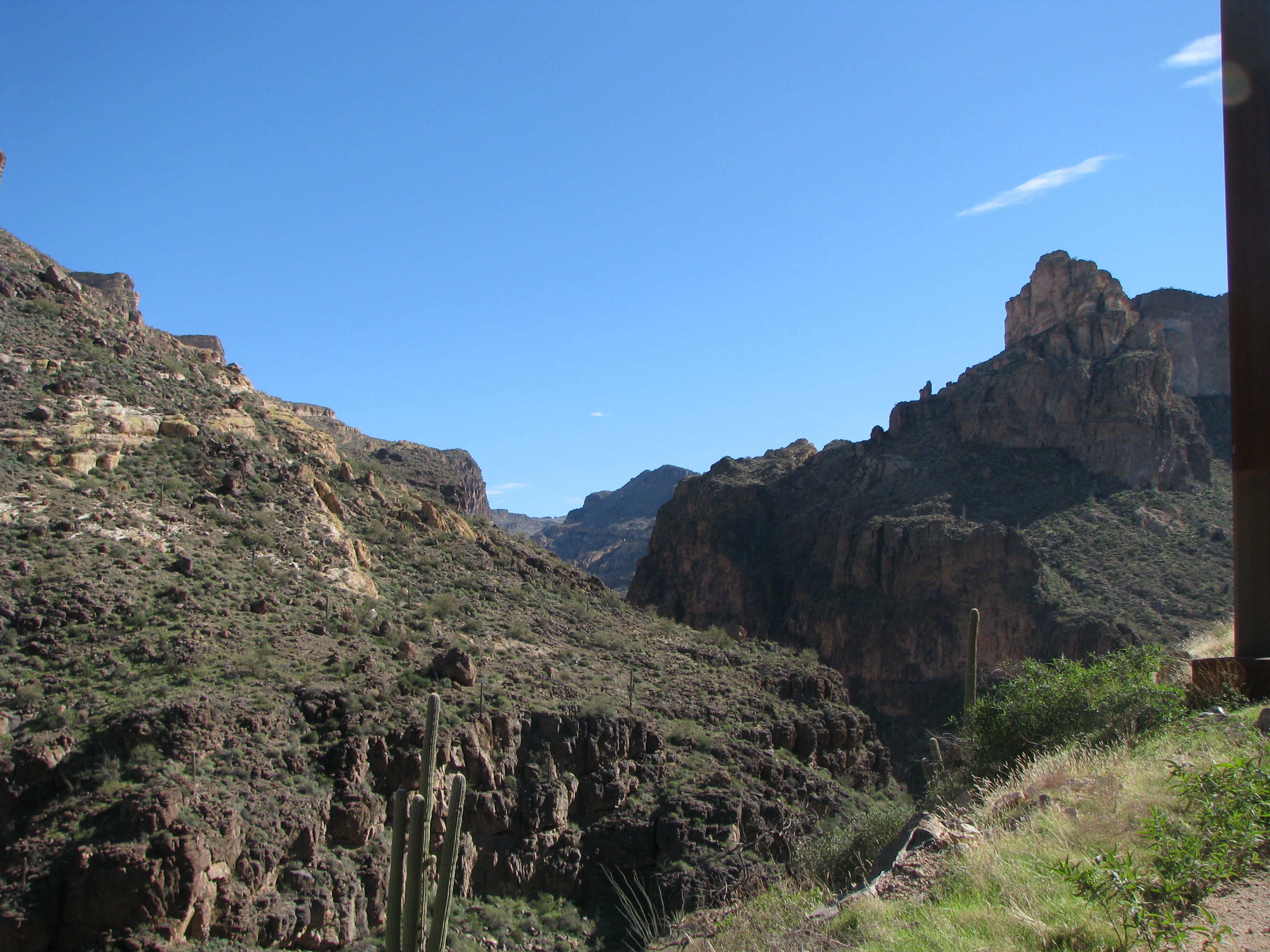
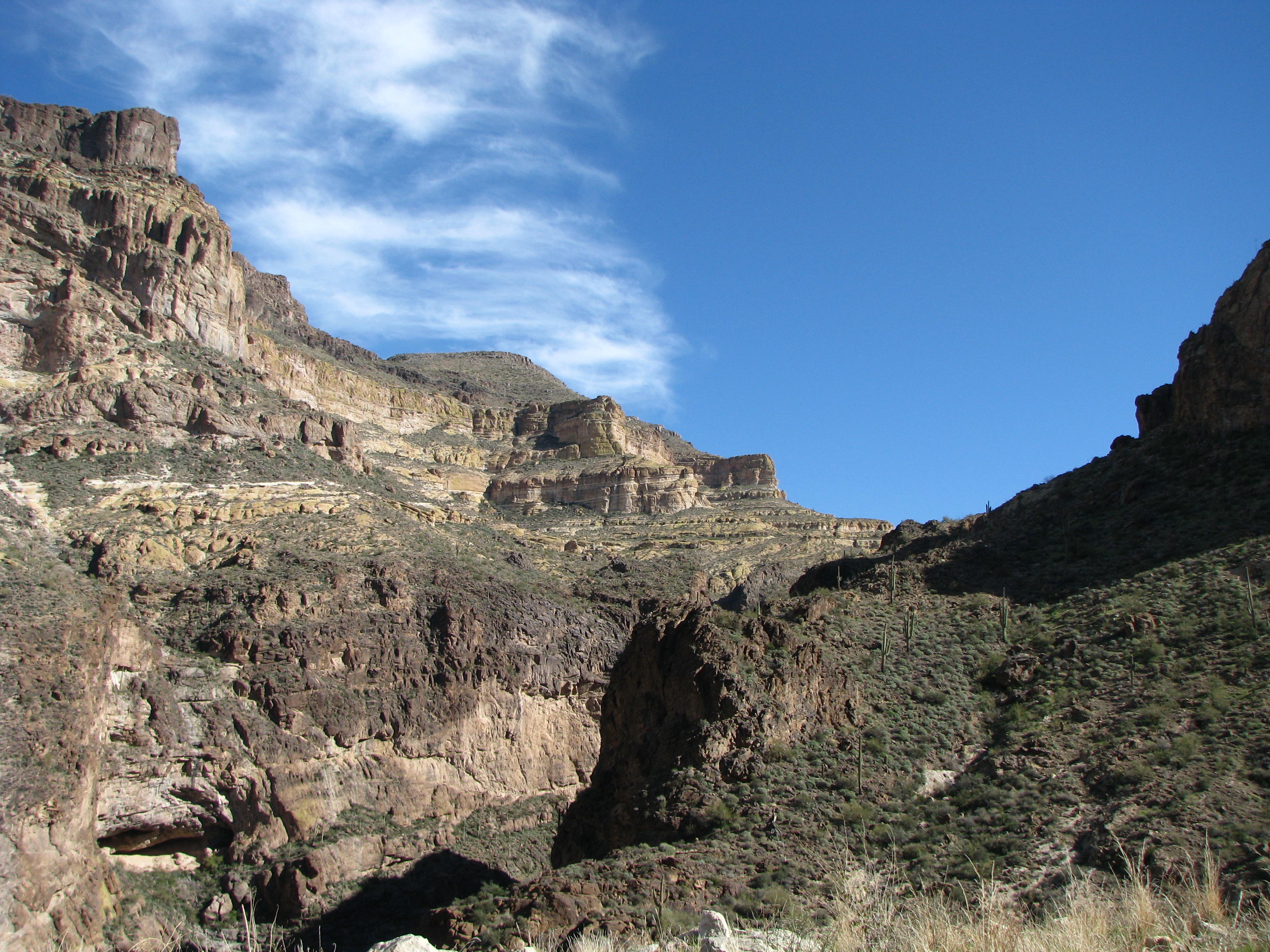
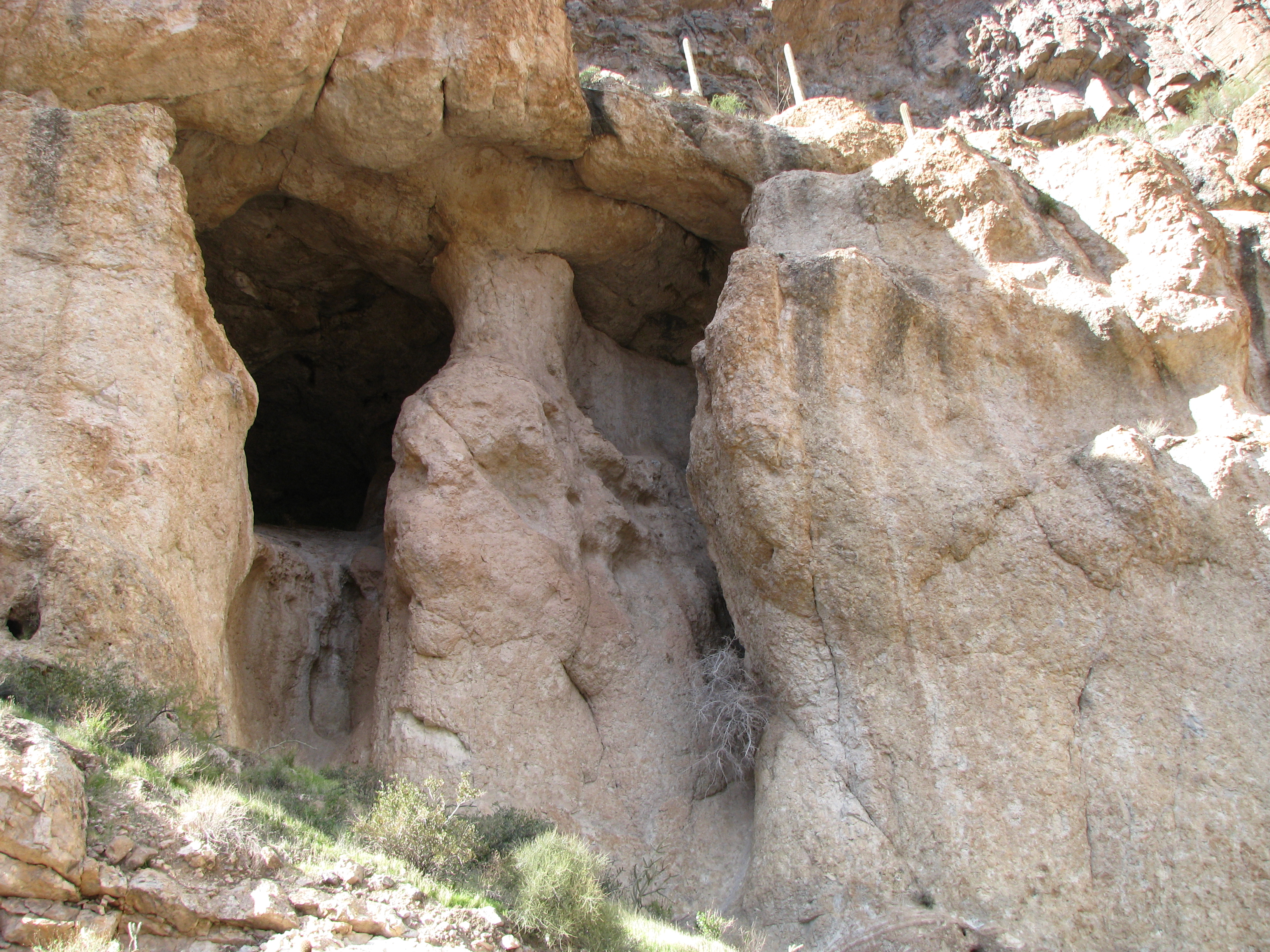
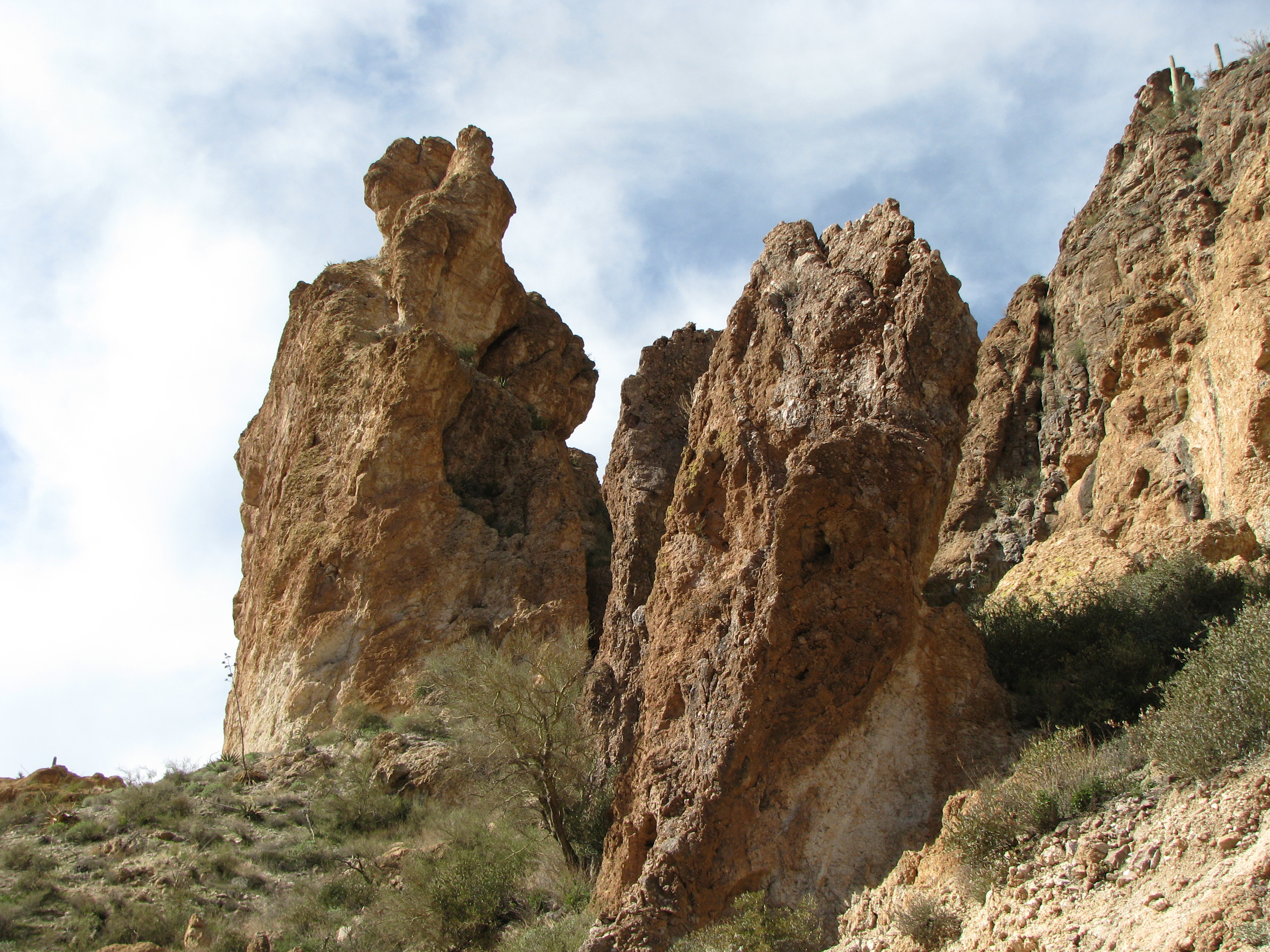
The Golden Hoodoos of Bryce


This post isn’t so much about a hike (although I took a short one) , but is just a sharing of the visual experience of Bryce Canyon National Park. After spending a couple of days at Zion National Park (see my previous entry about Angels Landing), we drove with friends Doug (“The Commodore”) and Cathy Hull, up to Bryce Canyon.

Despite the name, Bryce is not really a canyon, but the edge of the Paunsaugunt Plateau, carved by wind and water into a series of “amphitheaters”. The rock is various colors of limestone (mostly yellow, white, and orange) carved into surreal “forests” of hoodoos, windows, and arches.

I’ll let the camera speak for me.

The road leading toward the park is an attraction in-and-of itself. It passes through an area called Red Canyon, which is quite picturesque, reminding you somewhat of the redrock area around Sedona back in Arizona.

As eye-catching as these preliminary scenes are however, they don’t begin to prepare you for the scenes inside the park itself.

Everywhere you look, the scenes of hundreds and thousands of hoodoos standing their ageless duty as silent sentinels in this beautiful setting simply take your breath away. This is a holy place.

Enjoy!

Have a nice summer. I’ll see you all next hiking season.

Meanwhile, I’m going to catch some walleye!

Posted in Arizona hiking | Tagged , , , , , | 5 Comments

Zion Park – Angels Landing – My Excellent Adventure


Colleen and I are on our way back to Minnesota, taking a non-direct route.  Right now we are in Zion National Park, in the southwest corner of Utah.  The park has a variety of hikes of various categories.  One of the most popular is a hike to a peak called “Angels Landing”.

Today I tackled that route.

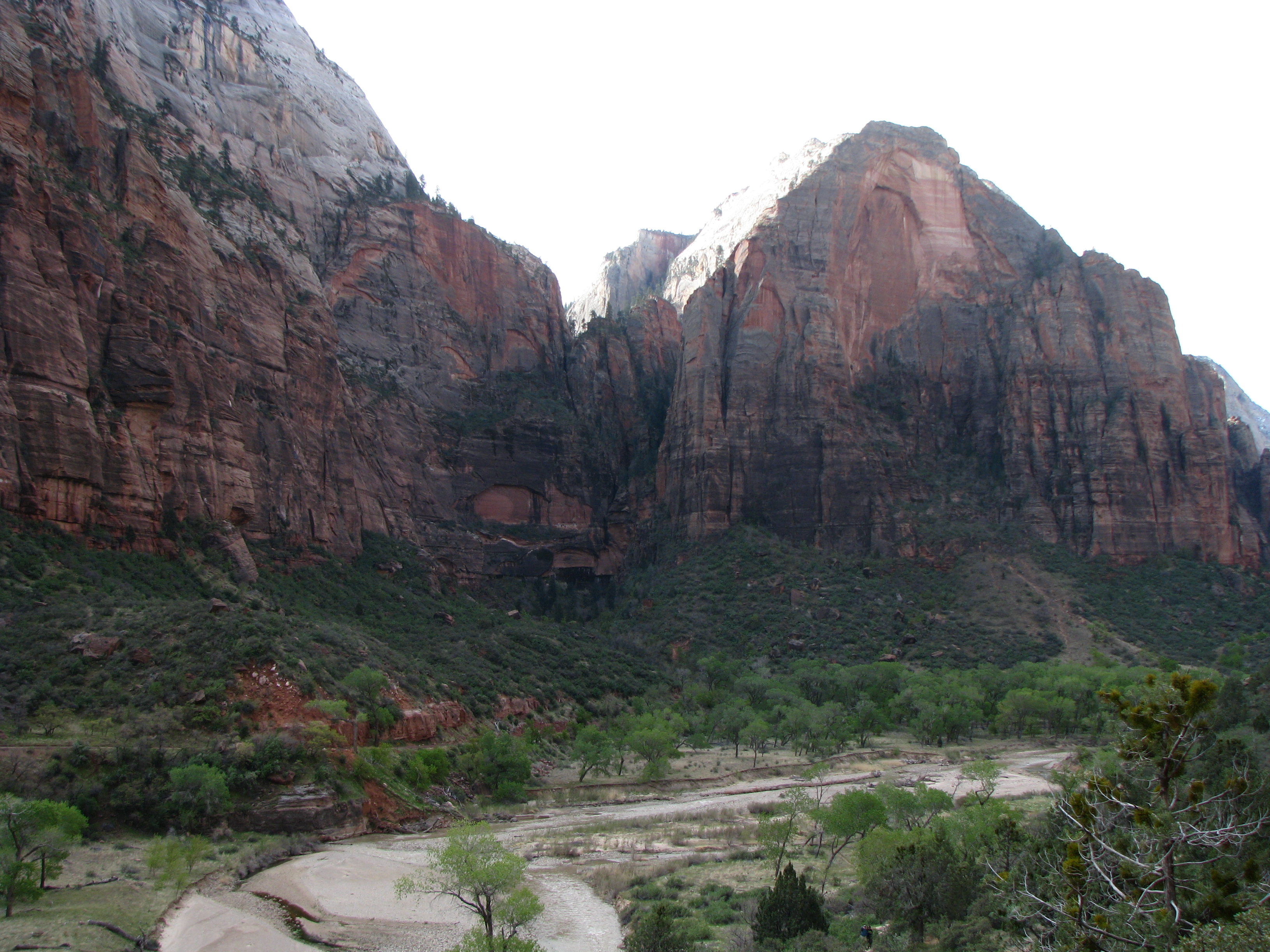
The destination for this hike is the top of the rock formation seen in the right of the photo above.  The photo is taken from the trailhead, and the “Landing” is about 2.4 miles and 1,700 vertical feet away.  The route meanders for about a half mile along the left side of the Virgin River, then ascends up the cliff face via a series of switchbacks to the “saddle” in the middle of the photo.

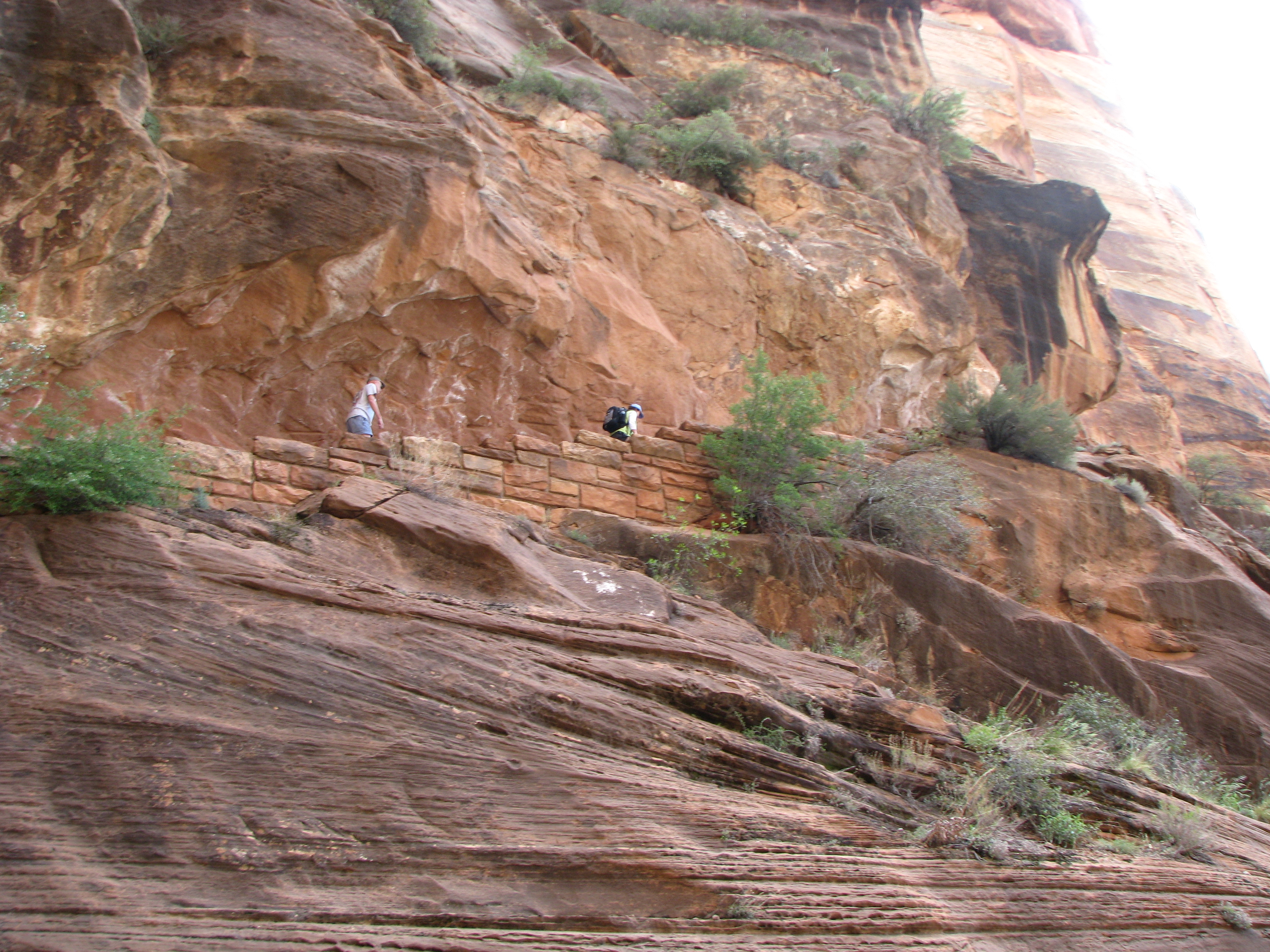
In the photos below you can pick out hikers at various stages of that vertical ascent.

This portion of the hike, although a little bit challenging due to the constant exposure to looooong drop-offs, turns out to be quite easy.  The trail surface is smooth and wide, and in excellent condition, and the switchback inclines are gentle.  Soon you find yourself ignoring the fact that you’re essentially working your way up a 800 foot vertical cliff, and you start taking in the awesome views of the canyon scenes being revealed below you.

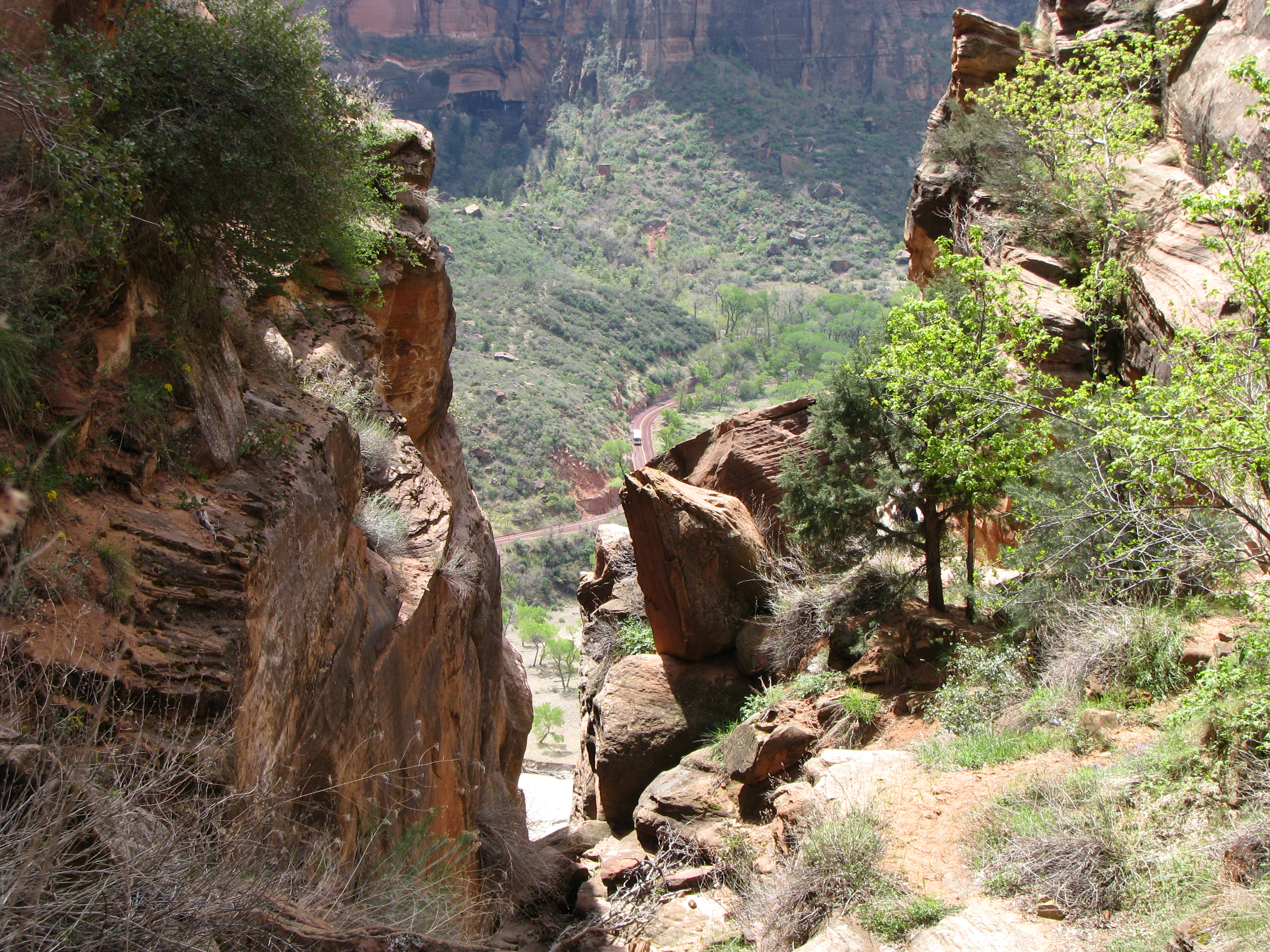
Yes, that’s a double-length bus on a two-lane highway you see far below!  The trailhead is just around that bend in the road behind the bus.

Finally we’re approaching the level of the saddle you saw in the first photo.  Note the hikers above me, almost dead-center in the photo below.

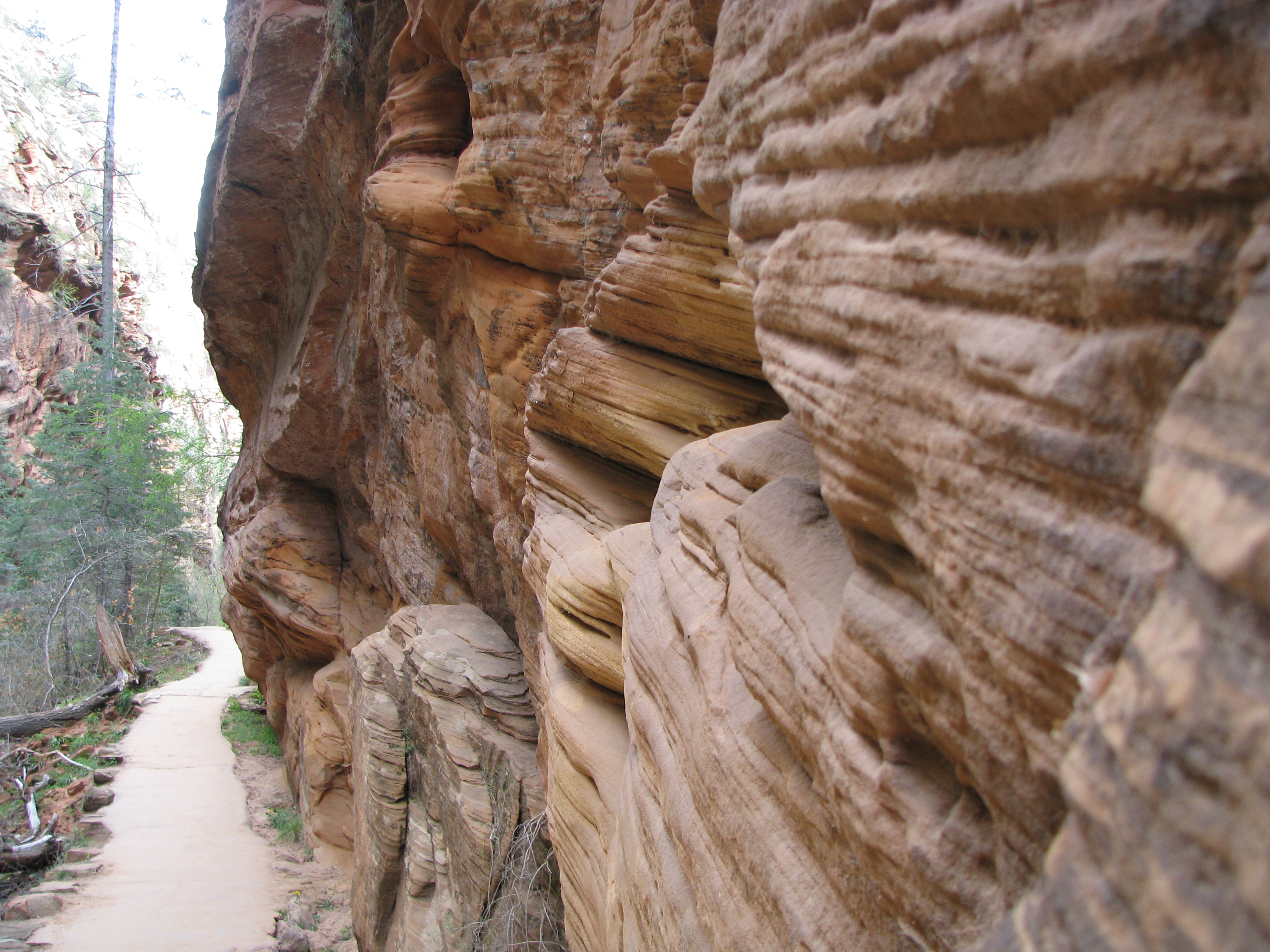
When you gain the saddle, you actually find yourself in a hanging canyon, with great vegetation, and even more important a narrow passage with high sides shading you from the sun.  This gorge runs pretty flat for about a third of a mile, and (because of the coolness) is nicknamed “Refrigerator Canyon”.

Over the ages the canyon walls have been eroded into strange an beautiful patterns and textures.

After you get comfortable with this easy hiking you suddenly find yourself in another vertical ascent, this time a series of about 35 or so quick switchbacks up a “chimney” at the head of the canyon.  This segment, named “Wally’s Wiggles” after the early park manager who designed them, pulls you up about 250-300 feet to the Zion Canyon rim.  Below is a view looking down from the top of the Wiggles — only a handful of  the switchbacks are visible in this view.

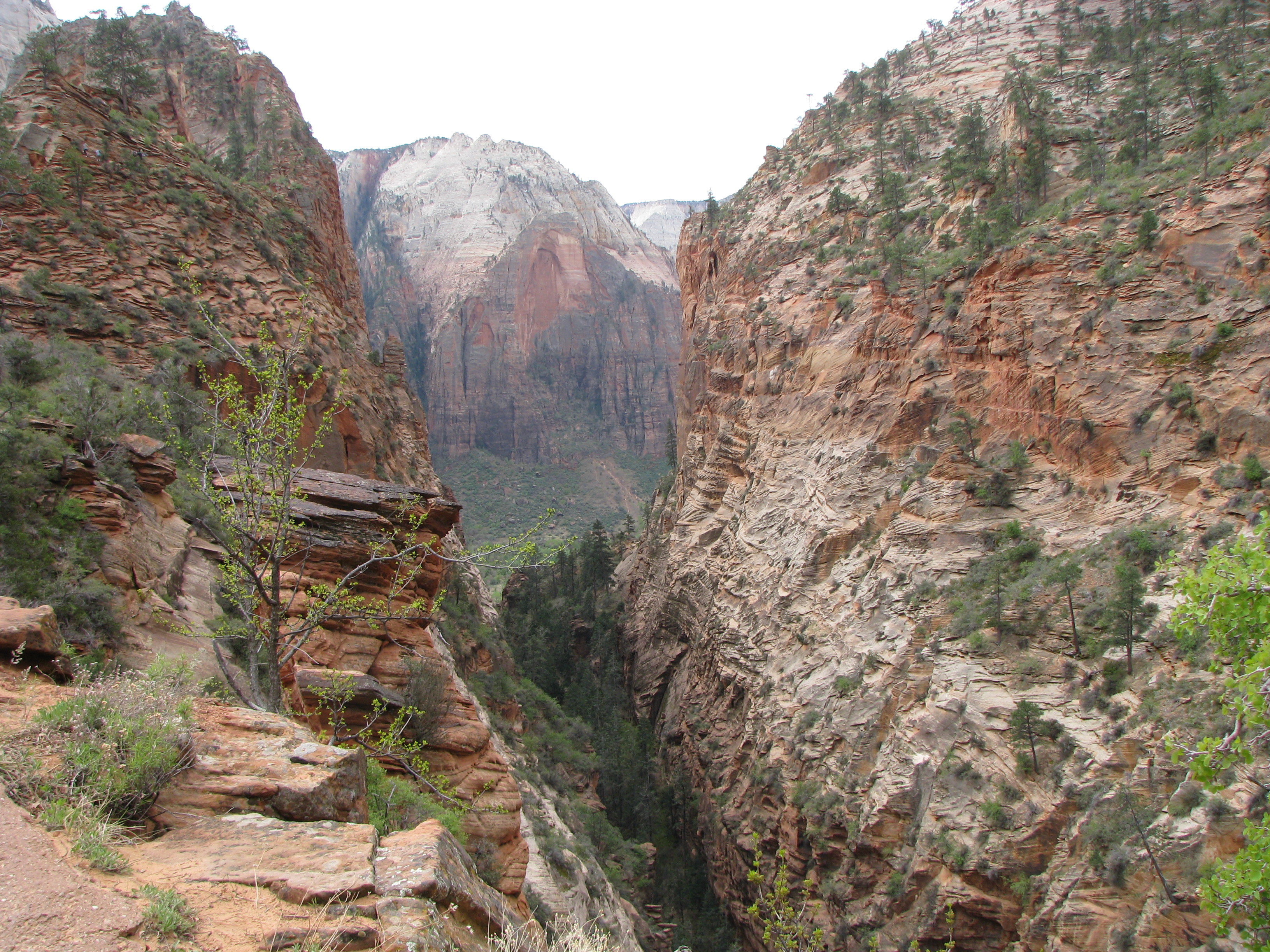
Well, OK, now you’re at some serious elevation, about 1,400 feet up.  The views are breath-taking.

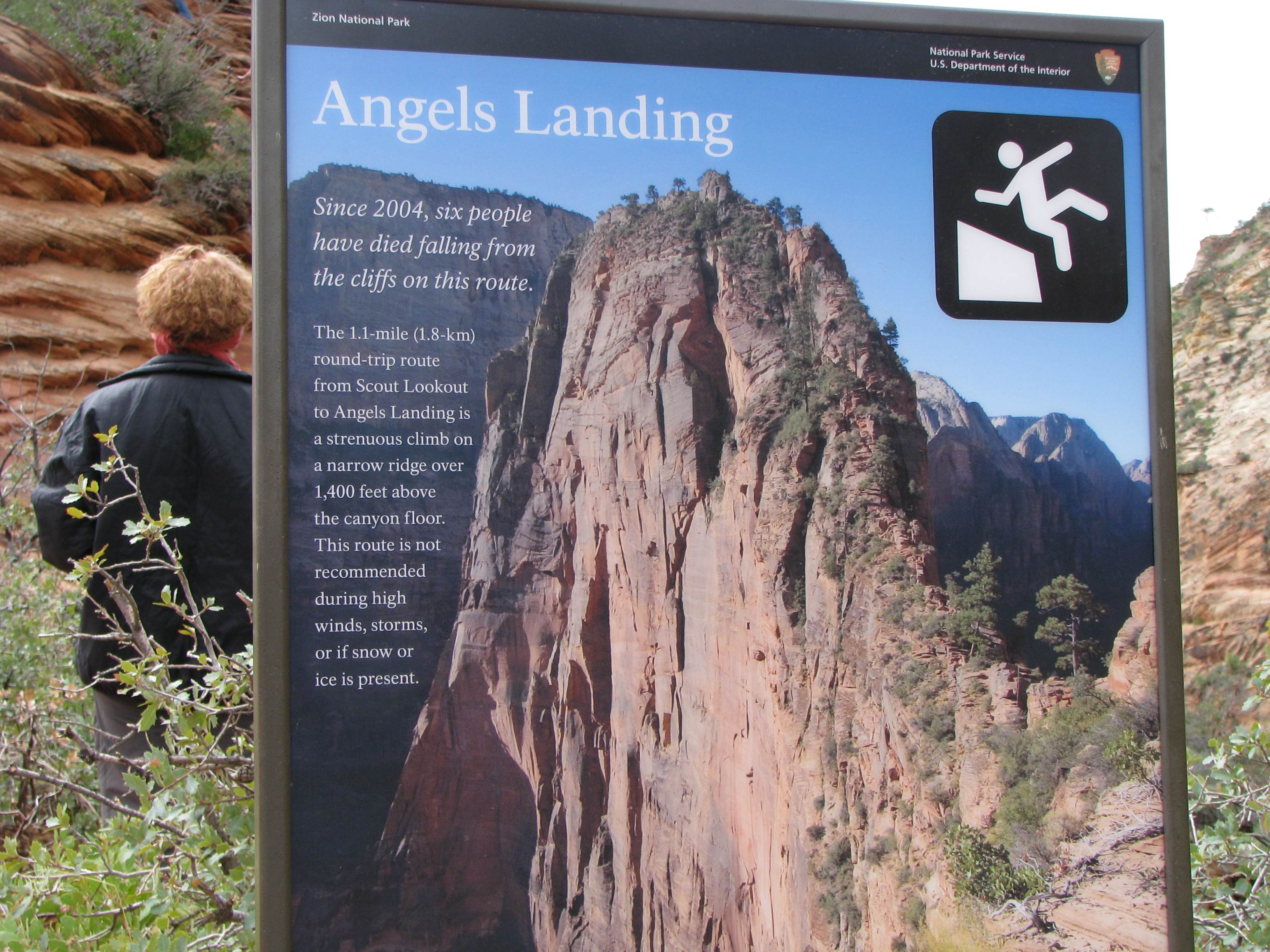
This location is known as “Scouts Lookout”, and is probably where I should have turned around and headed back down, but one final half-mile segment beckoned, the final leg to the “Landing”.  Can’t say that I wasn’t warned! (Click the photo below for a more readable view.)

Look at the sign above, and note the first lone pine.  About 50 yards shy of that tree is where I lost my nerve and turned back.  Needless to say, I wasn’t taking a lot of photos, but basically this is a narrow ridge line with sheer drops on either side.

A heavy chain is your “trail”. Took the photo below early on the segment, then decided the camera work was reducing my traction by 50%, so no more pictures!  This chain extends all the way to the top, but I decided that once you’ve seen a couple hundred yards of the chain, all the remaining links are going to look pretty much alike.  I returned to the lookout, enjoyed my lunch, and headed back down.

At the bottom of the cliff, I took a detour to the trailhead via a side trail which took me to a nice area with waterfalls and a striking array of cottonwood trees along the river.

Editorial comment:  Here’s a link to an old discussion about the safety of this route.  Personally, I hope it remains the same.

http://www.nationalparkstraveler.com/2007/06/should-anything-be-done-angels-landing

Posted in Arizona hiking | Tagged , , , , | 9 Comments

Mount Peeley — some options for next season


Today three of us, George, Peter, and me, went exploring again in the high country of the Mazatzal Wilderness.

We drove to the Mount Peeley trail head.  This is an adventure all in itself, 8 or 9 miles of single lane (NARROW single lane) abandoned mining road now called
Forest Road 201.  The road surface is quite good, actually, but not suited to large vehicles.  Georges’ ForeRunner was ideal, but a crew cab long bed dually would be out of place.

Very scenic, just enough dropoffs to keep your attention, but not enough to be scary.

The climb to the trailhead takes your over some 6,000+ foot ridges, and eventually drops down into a small saddle at about 5,600 feet where the trailhead lies.  It was 90+ degrees back at the RV Resort, but a very pleasant 62 degrees at the trailhead.

Because of the elevation, you find yourself in a forest environment, mainly Ponderosa pine and alligator juniper.

This trailhead actually is sort of a mini-hub, serving several routes, some of them multi-day backpack trips, and a couple of more “local” hikes.  The trailhead is also a node on the Mexico-to-Utah 700-mile Arizona trail.

We hiked a short distance, perhaps 2 miles round trip up toward the summit.  The summit is about 2.5 miles from the trailhead, and 1,400 feet of ascent.  Some days it’s OK to be lazy, so we only did the easy lower part.

George brought some good maps along, and we have plotted out a nice “combination” hike for next season which allows using this trailhead for two simultaneous hikes. Our plan is this….

First, everyone rides together to the Mount Peeley trailhead.  Then…..

Hike #1.  Some hikers will want to “bag the peak”.  This is a 5 miles hike, with 1,400 feet of ascent.

Hike #2.  Some other hikers will want to hike Arizona Trail down the mountain to a second trailhead.  This is a 12-mile route, containing a total of 4,000 feet of descent and 1,500 feet of ascent mixed in.

The hikers who do the summit hike (#1) will naturally return to the original trailhead where they will ferry the vehicles back down FR201 and pick up the long-distance hikers and we all travel merrily back home.

“Simple, huh!” said George as he refolded his maps.

Enjoy the views below.

And always remember, be careful out there!  If you see GPSJoe, tell him to call home.  http://www.paysonroundup.com/news/2010/nov/23/search-missing-hiker-called/

Posted in Arizona hiking | 7 Comments

Peak 5057


Peak 5057 (one of Joe’s “Six Challenges”) was the Friday destination.  Two routes were employed.  One group went up the eastern route via Carney Springs, and a second group took the western route via Hieroglyphic Canyon.  A subset of the western group had a destination of the “Upper Pool” a site near the head of Hieroglyphic Canyon, below the ridge line rim.

Up, Upper, Uppest!

This was an ambitious hike, lots of elevation, over a sometimes not-so-obvious trail.  When you go be sure to carry extra water, gloves (a few segments of the route require a four-point stance), and sturdy ankle-support shoes.  Not trying to scare anyone off …. this is a very “do-able” hike, and the trail has been sketchily cairned.  Just sayin’ to keep a part of your attention in “navigation mode”.   Disclaimer complete.

The first leg of the hike is the familiar trek up Hieroglyphic trail to the pool area.

Take break and rest your legs, because you’re now heading into a very vertical environment.  I’d estimate that the mile-and-a-half between here and the upper pool gives you about 1,500 feet of altitude gain.

Travel is in a wide uphill canyon, generally on the upper talus of the right (east) side of the canyon.

After about 3/4-mile the route transitions from talus to vertical surroundings.  The scenes are spectacular.

Sometimes you need to look back and see where you’ve been.

The closer you get to the rim, the rockier the route.

Eight of us made our destination the upper pool where we had lunch, then headed back down.   We learned by radio that the remainder of our groups gained the 5057 summit about an hour later.

I want to thank Dana and Debbie for the pioneer and missionary work on this spectacular route, and especially Debbie for volunteering to lead us after Dana feigned a sports injury on the softball field to avoid being our leader.

Posted in Arizona hiking | 2 Comments

The Trail of the Lonesome Pine


About 60 years ago, I and my two next-younger brothers, Lyle and Art, skipped church one Sunday and walked to the town of Mahnomen, 12 miles east of us, and went to the movie “The Trail of the Lonesome Pine”.   I think Henry Fonda was the male lead.  It was the first movie I’d ever seen in Technicolor.

Today we hiked up Peralta trail, then took a side trip out to another Lonesome Pine.  The hike was a repeat of a trip earlier in the season (actually a three-peat if you count the Peralta to First Water cross-wilderness hike a few weeks ago).

But a lot of people had missed the earlier runs, so I led a group of 15 as an alternate to bagging Picacho Peak, another hike the club did today.

What’s more to say about Peralta to Fremont Saddle — you’ve read it all before, so I’ll just post a few nice scenes from today.

Mitch enjoying his lunch break……

Gary, posing on a cliff with Weavers Needle…..

Below is a view into the east from Lonesome Pine overlook.  The formation in picture center is Miners Needle, about 4 or 5 miles away.  I zoomed for the second photo, so you can see the eye of the needle.  Then look back at the first photo to pick out the faint eye.

More miscellaneous scenes…..

Posted in Arizona hiking | 5 Comments

Upper Dwelling – Tonto Monument


Today (Feb 3rd) a group of us took the backcountry hike to the “Upper Cliff Dwelling” ruins in Tonto National Monument.  This hike (about 3 miles) is led by a Park Ranger (you cannot go without a Park Service escort).  I’ve always been fascinated by the history of these vanished peoples, so having a knowledgeable guide makes the hike a great experience.

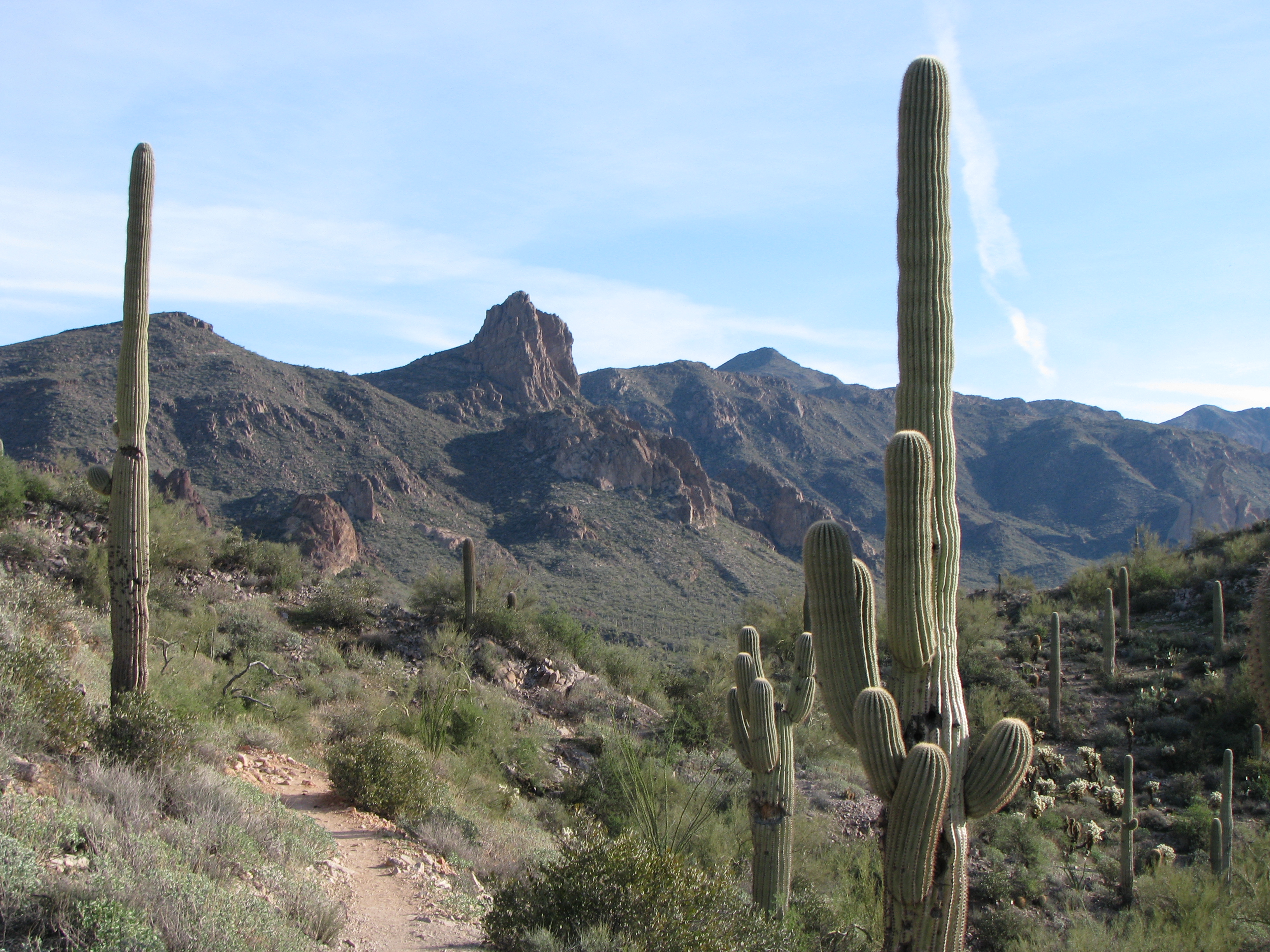
The hike starts in a quiet canyon which has a small spring-fed stream.  This source of reliable moisture nurtures a wide variety of plant life, small grassy meadows, and wildlife. Deer, cougars, and bear are among the regular visitors in the area.

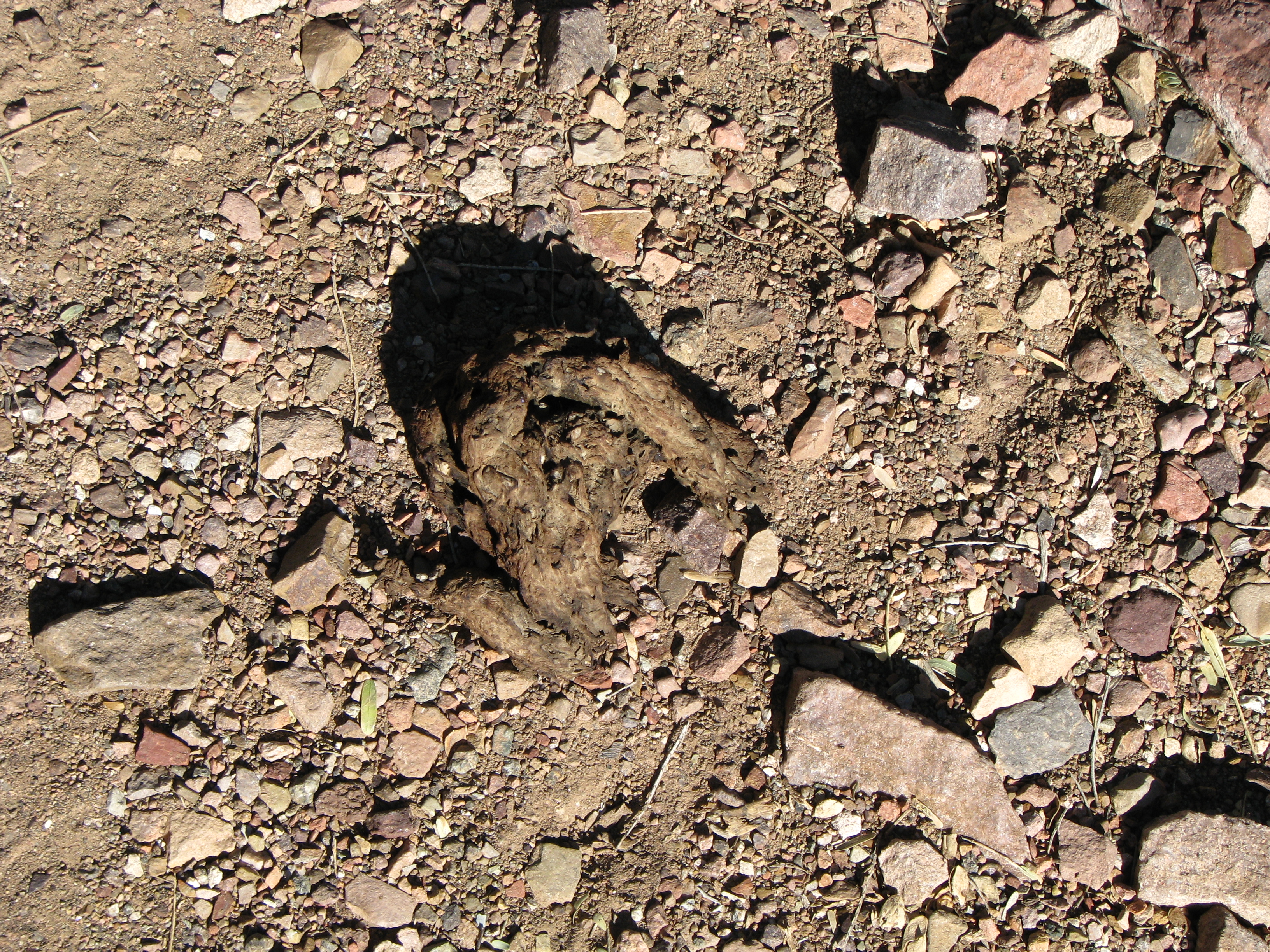
“Does a bear shit on the trail?”  Yes — see below. (At least that’s what the Ranger said it was.

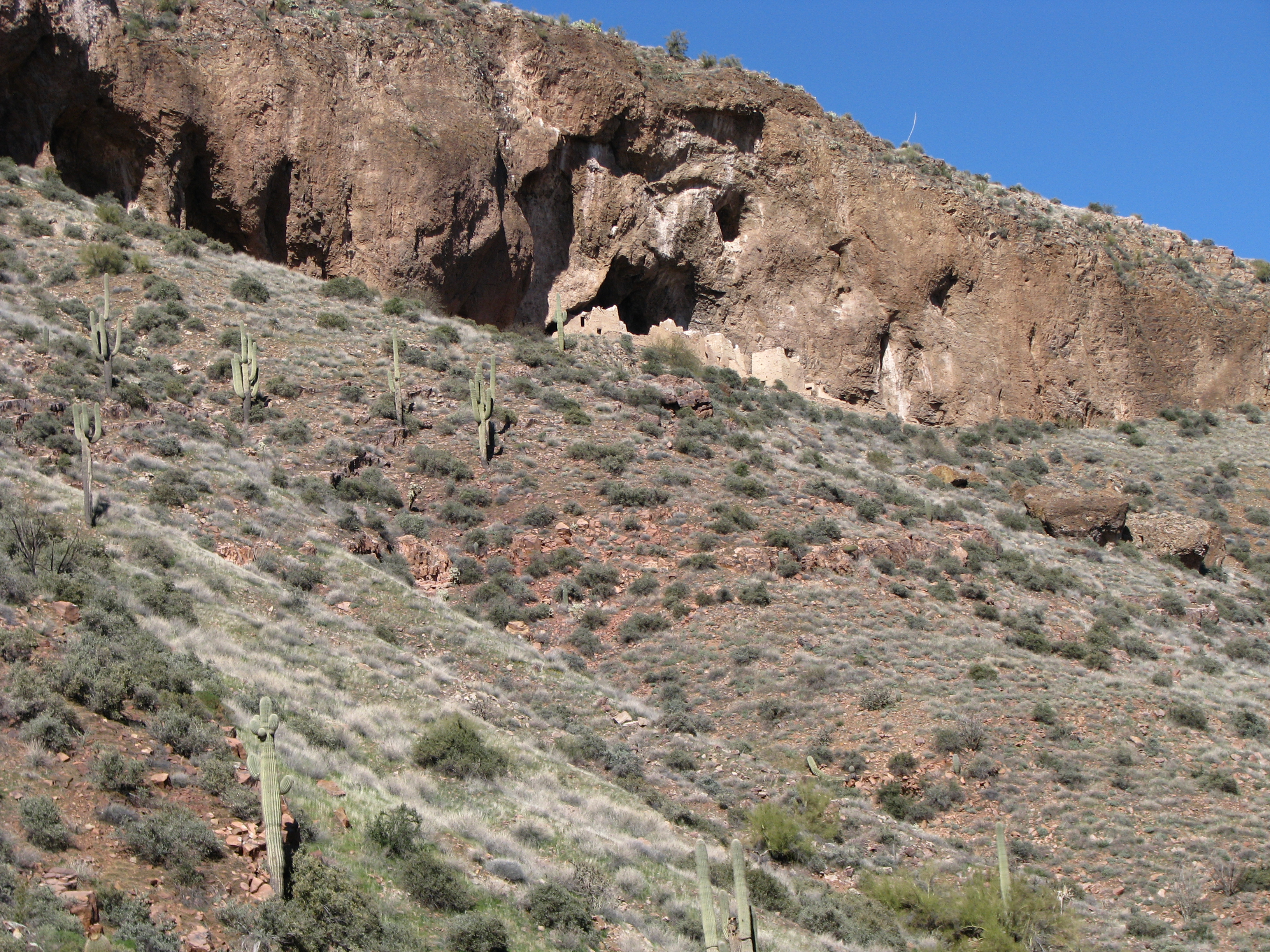
After about a half mile the canyon opens up, and our destination is seen about 600 feet above us in an alcove on the canyon wall.  The route up is by a long series of switchbacks, but it’s a well constructed trail, so not a difficult ascent.

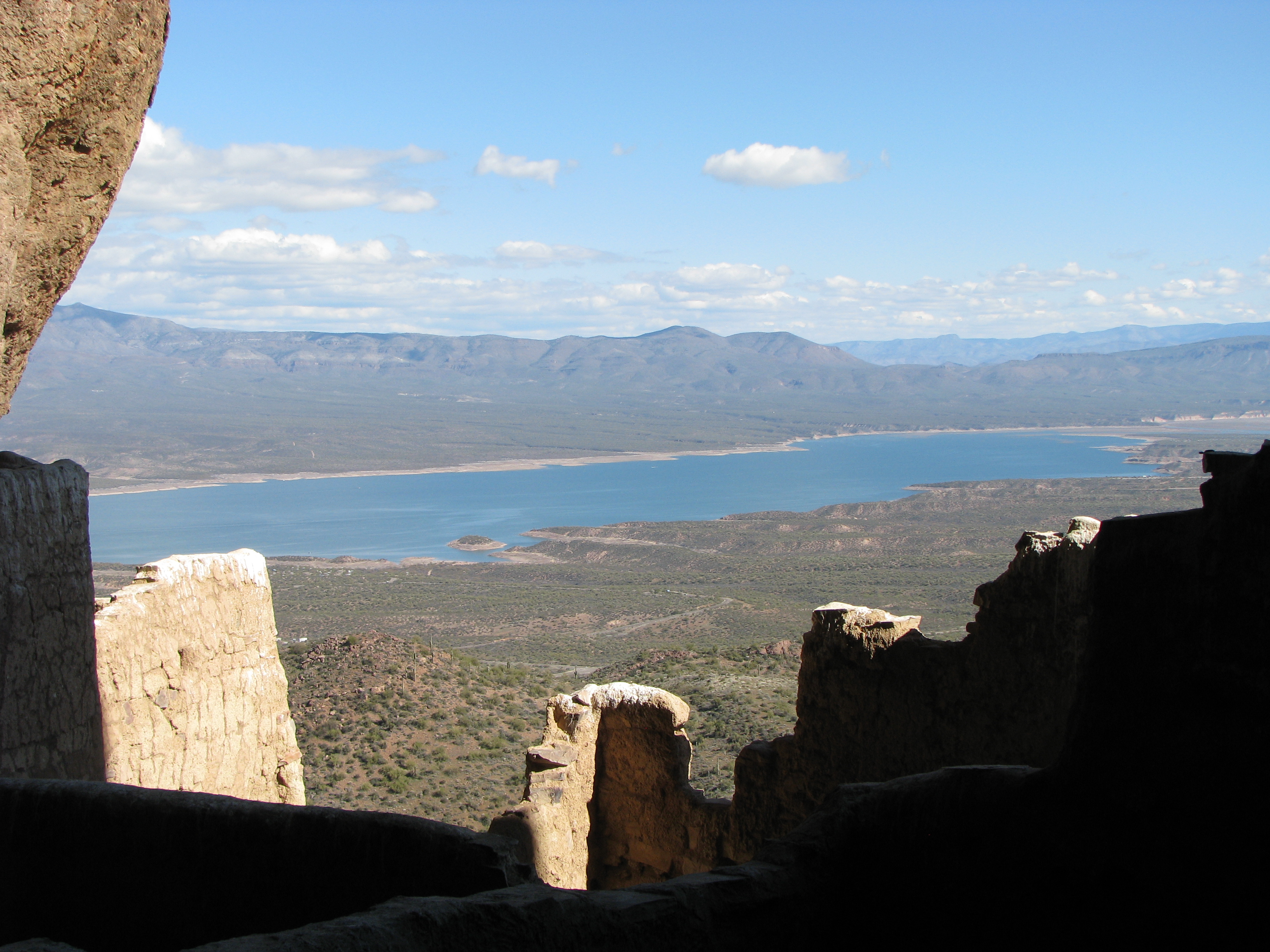
During the climb you’re treated to awesome panoramic views of the Tonto Basin, Lake Roosevelt, and the Sierra Ancha mountain range in the distance across the basin.

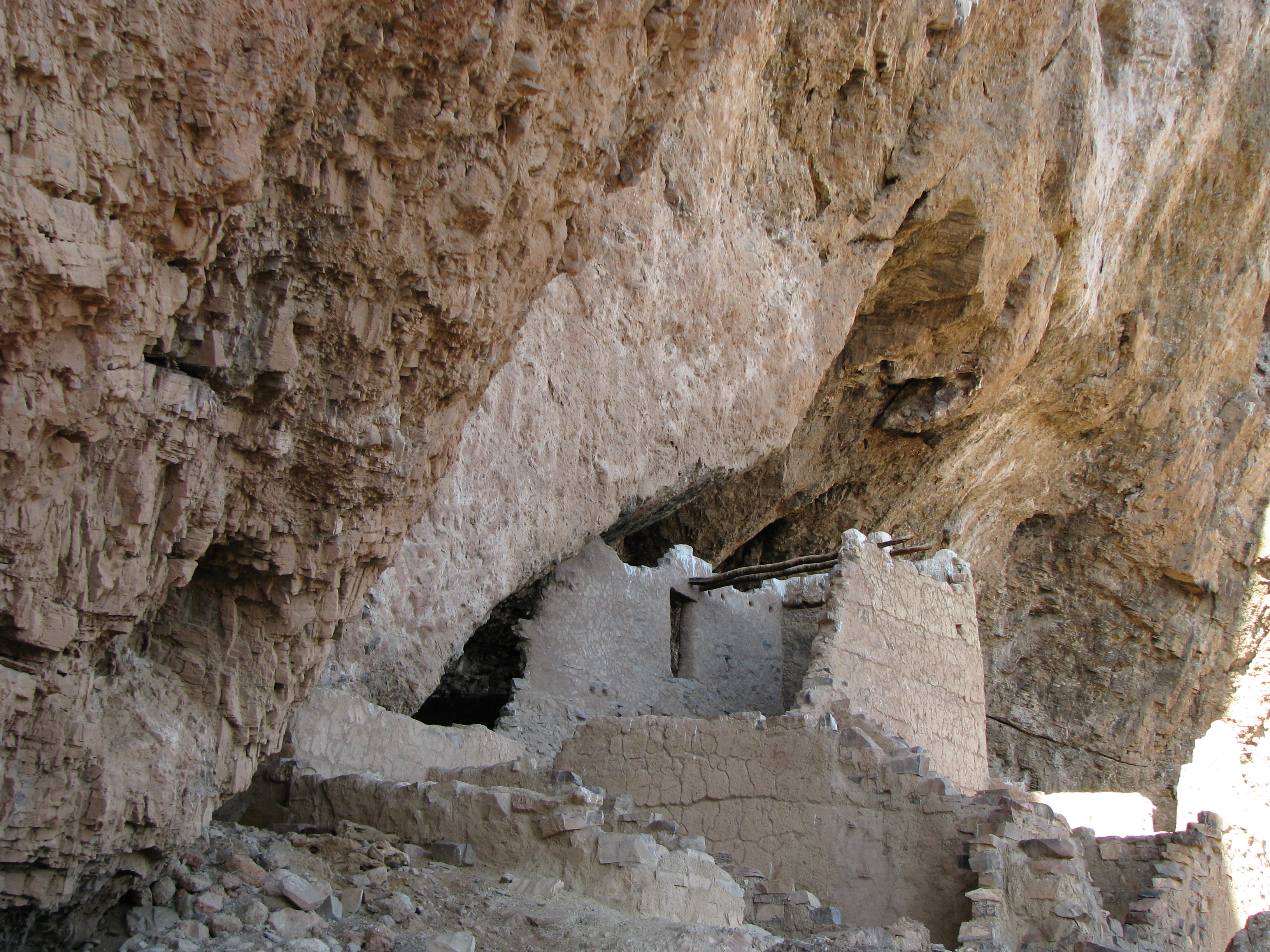
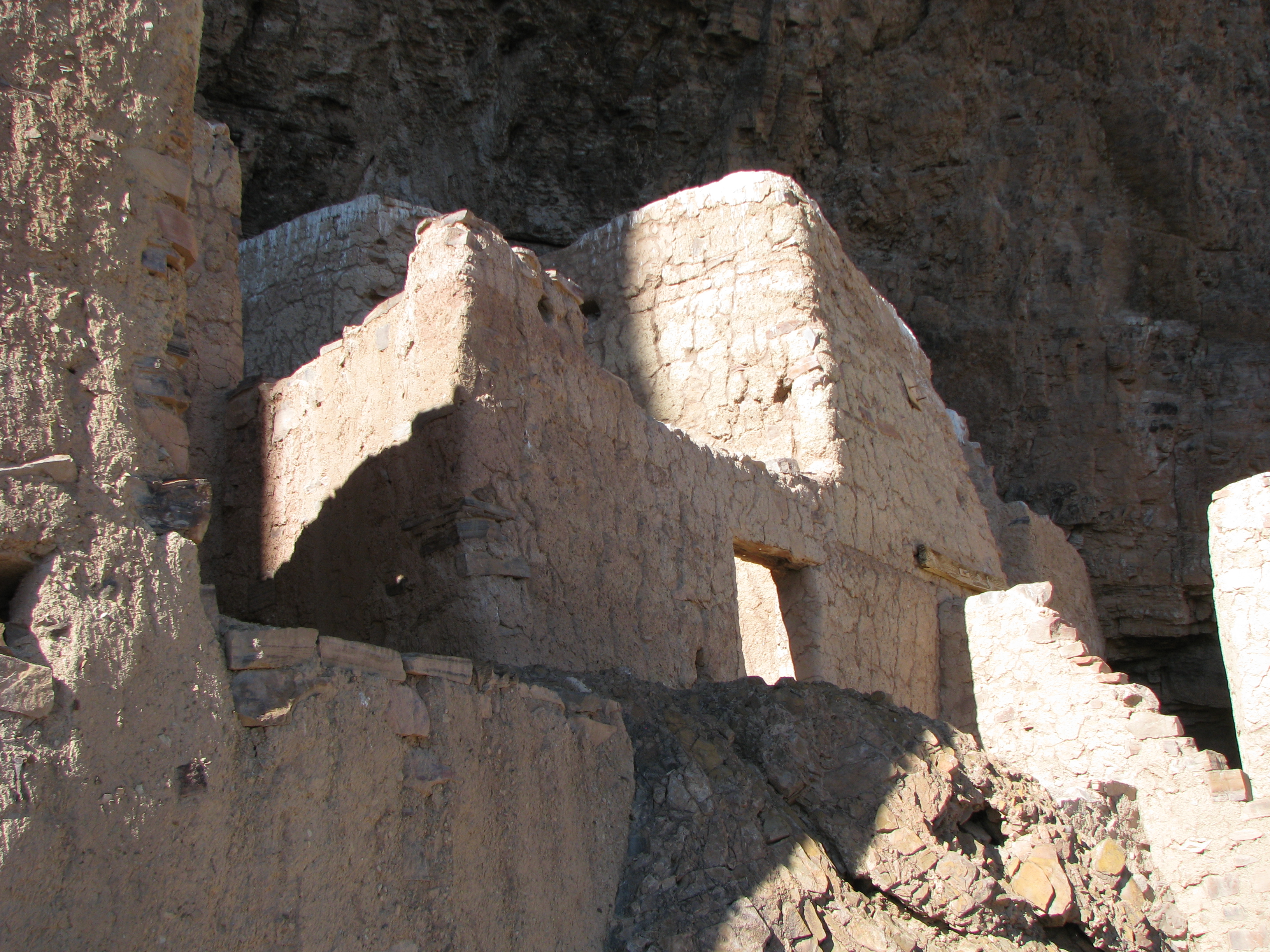
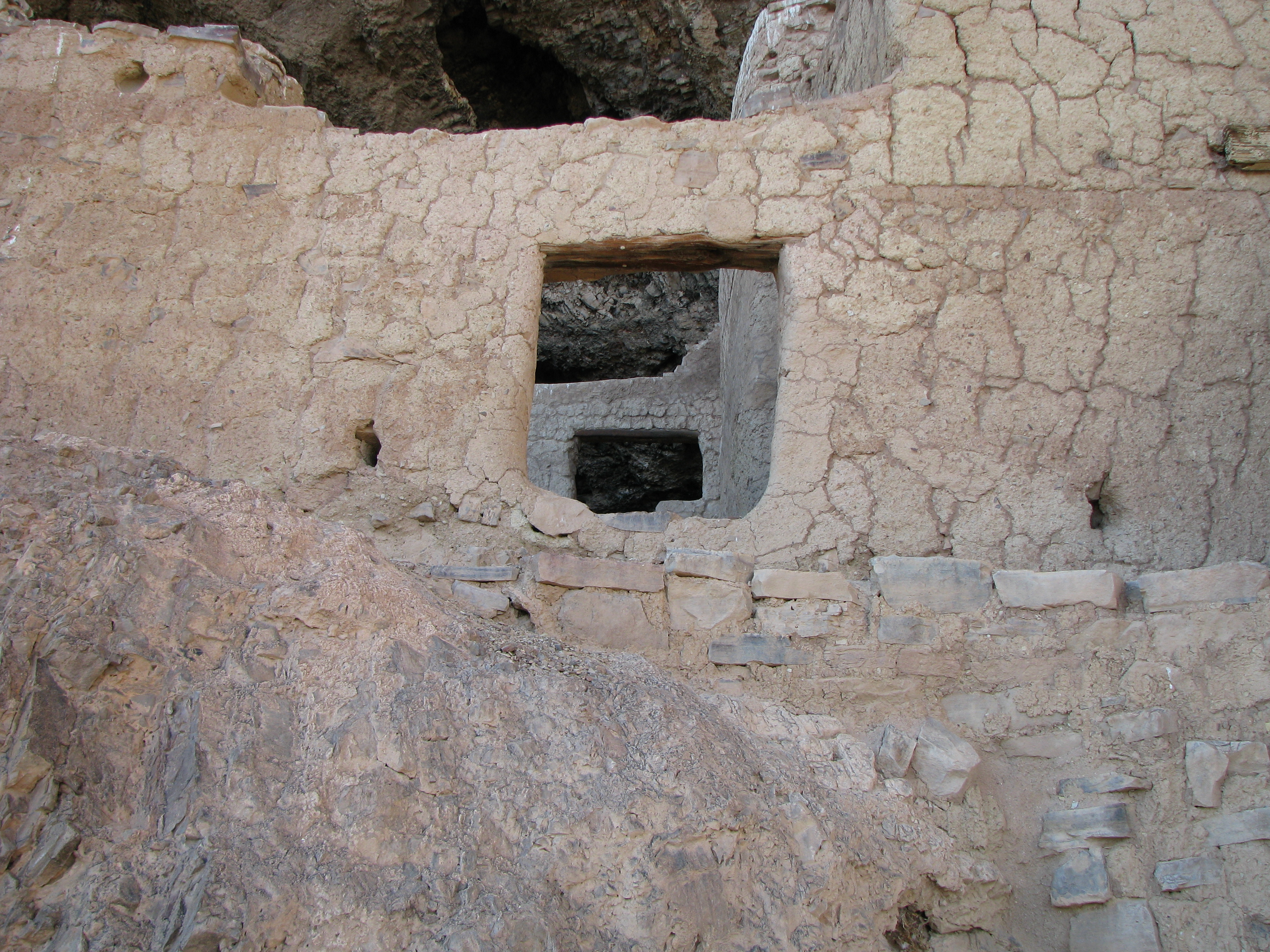
Eventually we reach the ruin.  This structure contains about 14 rooms.  Construction started about 1250 AD and the dwelling was occupied until approximately 1450 AD, when it was abandoned and the residents migrated away.

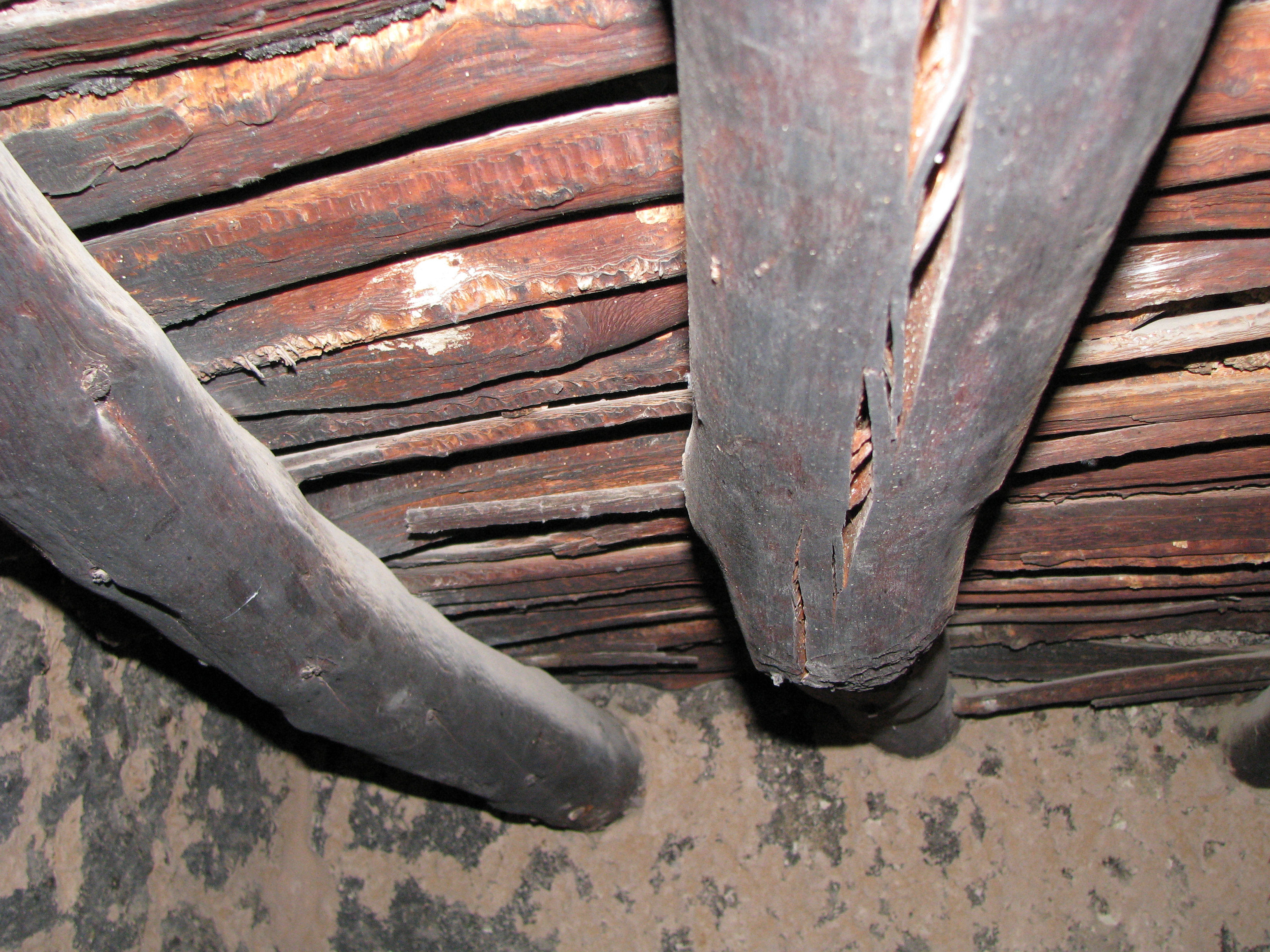
It amazes me that these beams, approaching 800 years old, still support a heavy floor for the room above!  I wonder how my basement joists will look in 750 years!

What price would a modern day homebuyer pay for views like these?


Posted in Arizona hiking | 8 Comments

Miners Needle – And another lost goldmine!


Wednesday of this week took a short hike (about 5-1/2 miles) from Peralta trailhead out to Miners Needle, using the Lost Dutchman trail.

This is an easy hike which starts out with a short climb up across a rocky ridge (perhaps 200 foot altitude gain) then drops down into an easy hiking valley with great views of the Dacite Cliffs butte and a lot of interesting formations along the route to Miners Needle.
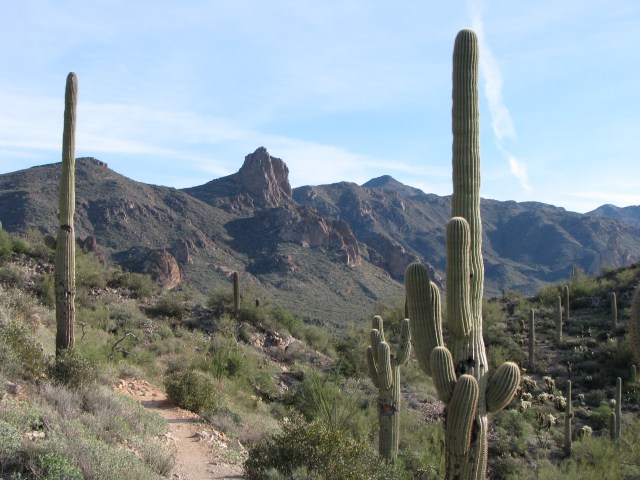
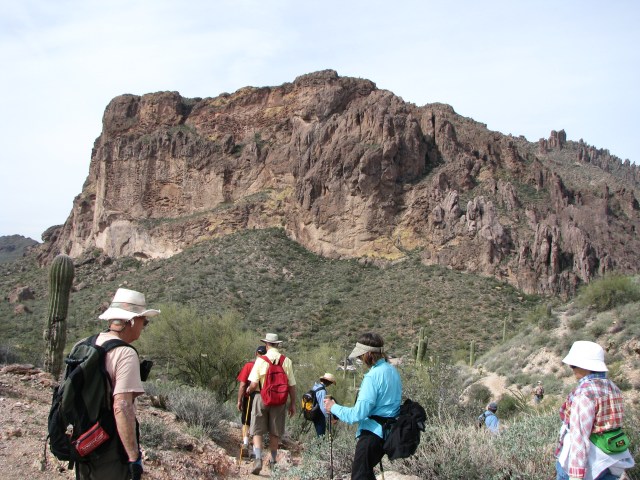
We were delighted to see the Mexican poppies starting to bloom.  Seems early to me, and is a sign we should have great color later into the spring.

The needle itself doesn’t rival the more impressive Weavers Needle, but is still quite photogenic.
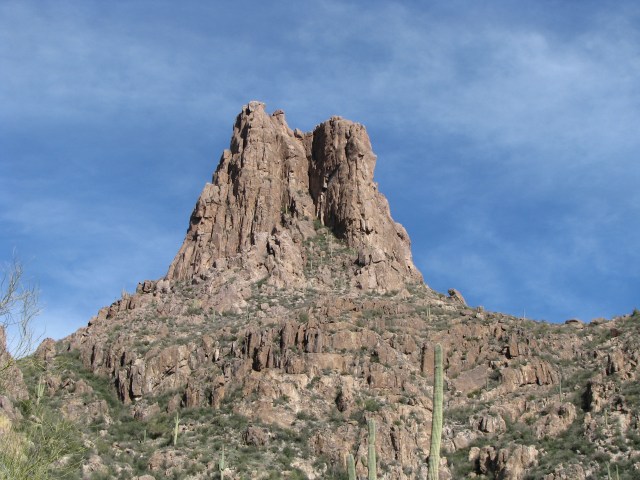
Here’s another angle, showing the eye in Miners Needle.  Weavers Needle doesn’t have one of those.
Here’s a story that I found on the web about the area just north of this needle.

The gold at Miners Needle

This is a story about lost gold in the Superstitions. But there is no Dutchman in it, nor any of the ill-starred Peraltas. Not even any of the Indians usually prominent in lost-mine stories and who invoke the curse of the Thunder God upon nugget-hunting trespassers or leap from hiding to kill all but one….

Two men figure in the legend of the lost rose quartz near Miner’s Needle.

One of them was Fred Mullins, who drove a stagecoach between the mining camps around Picketpost Mountain and the railroad town of Casa Grande. Some stories say he drove the “Pinal-Mescal run,” but Mescal, an El Paso and Southwestern rail stop five miles west of Benson, would be a long and crooked way to go for a train connection.

The other was one of Mullins’ regular passengers, one Wagoner. Wagoner suffered from a respiratory problem and came from somewhere back east. In time, the desert air and sunshine restored his health and his rambling hikes through the Superstitions made him financially independent.

Wagoner regularly boarded Mullins’ stage near the present town of Superior and got off in the foothills of the Superstitions and was always waiting by the side of the road when Mullins returned. Prospecting gave purpose to Wagoner’s outings and he usually exhibited a few specimens he had picked up. Sometimes they would show a chispas-a spark-of gold, but most of them were just pretty.

But one day in ’94 he unexpectedly and accidentally struck it rich. He had wandered far to the north of the Superstitions, into the hills north of the Salt River. He was a long way from the Pinal road and, since he had replenished his haversack in the new gold mining camp of Goldfield, he struck out for home almost directly across-country.

He crossed the Salt River at Mormon Flat. From Tortilla Flat he made his way southeasterly along Tortilla Creek, between high cliffs and steep slopes, until he reached more level country near Tortilla Mountain. He changed course, almost due south, through broken hills and at sunset found himself in La Barge Canyon.

He camped for the night and at sunrise took his bearings. He sighted Weaver’s Needle three miles to the west. He was almost due north of Miner’s Needle. He was bone-tired and almost out of food, but being alert for promising color in the rocks had become a habit. Suddenly, he saw it an outcropping of rose quartz, heavily laden with gold.

He carefully checked his position (by now he had become a skilled explorer) and made his way to Picketpost, carrying as much of the ore as he could.

During the next year he made repeated trips to his rich vein of quartz, dropping off of Mullins’ stage in the foothills and hiking out of the mountains a week later with a leather bag of ore. Unlike the prospectors who swapped their nuggets for chips at the faro tables or sold their claims for three-weeks worth of whiskey money, Wagoner carefully hoarded his earnings. When he determined that he had accumulated enough, Wagoner returned east.

Before he left, he told Mullins the location of his strike and said that he had marked it by planting a ring of trees around it. But planting trees in arid Arizona is not the same as planting trees in Michigan or New York and, untended, the trees must have died. Maybe other prospectors or Indians used the dry saplings for firewood. Mullins could never find them.

Posted in Arizona hiking | 5 Comments

Cross-Mountain Hike, Peralta to First Water


Friday (Jan 27th) we crossed the Superstition mountain range, from south to north, starting at the Peralta Canyon trailhead.  Took the trail up Peralta Canyon to the head of the canyon at Fremont Pass, then down into Boulder Canyon to the junction with Lost Dutchman trail in Boulder basin.  Crossed the basin on Lost Dutchman passing up over Parker Pass, then down into the First Water drainage, finally arriving at the First Water trailhead about 13 miles and 1,800 accumulated vertical feet later.  Thankfully the day was mild, in the 60’s with a high thin overcast most of the way.
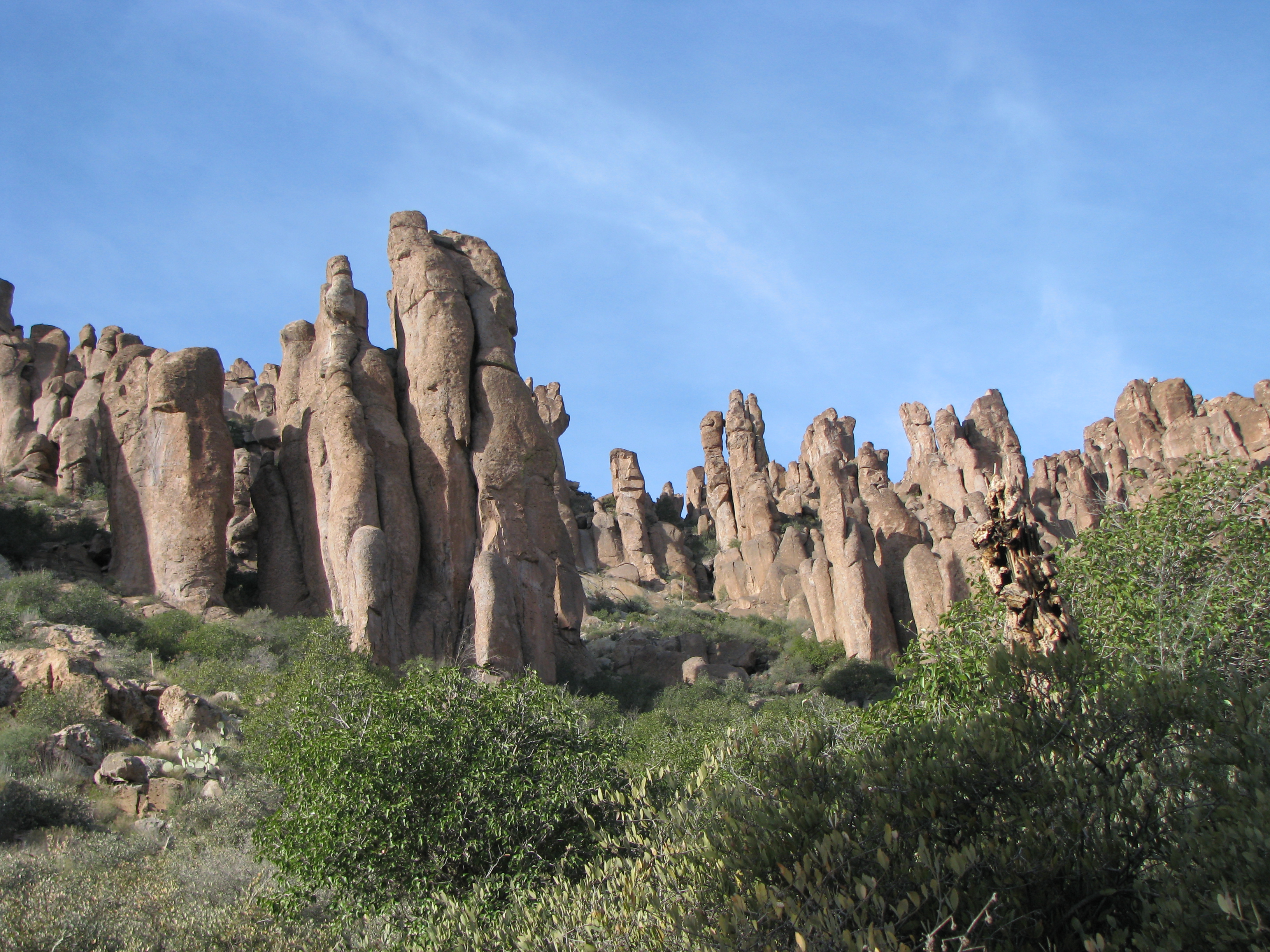
Peralta Canyon is always a favorite.  It makes you work, but the surroundings are beautiful.  You start out in a shaded canyon, rich with vegetation.

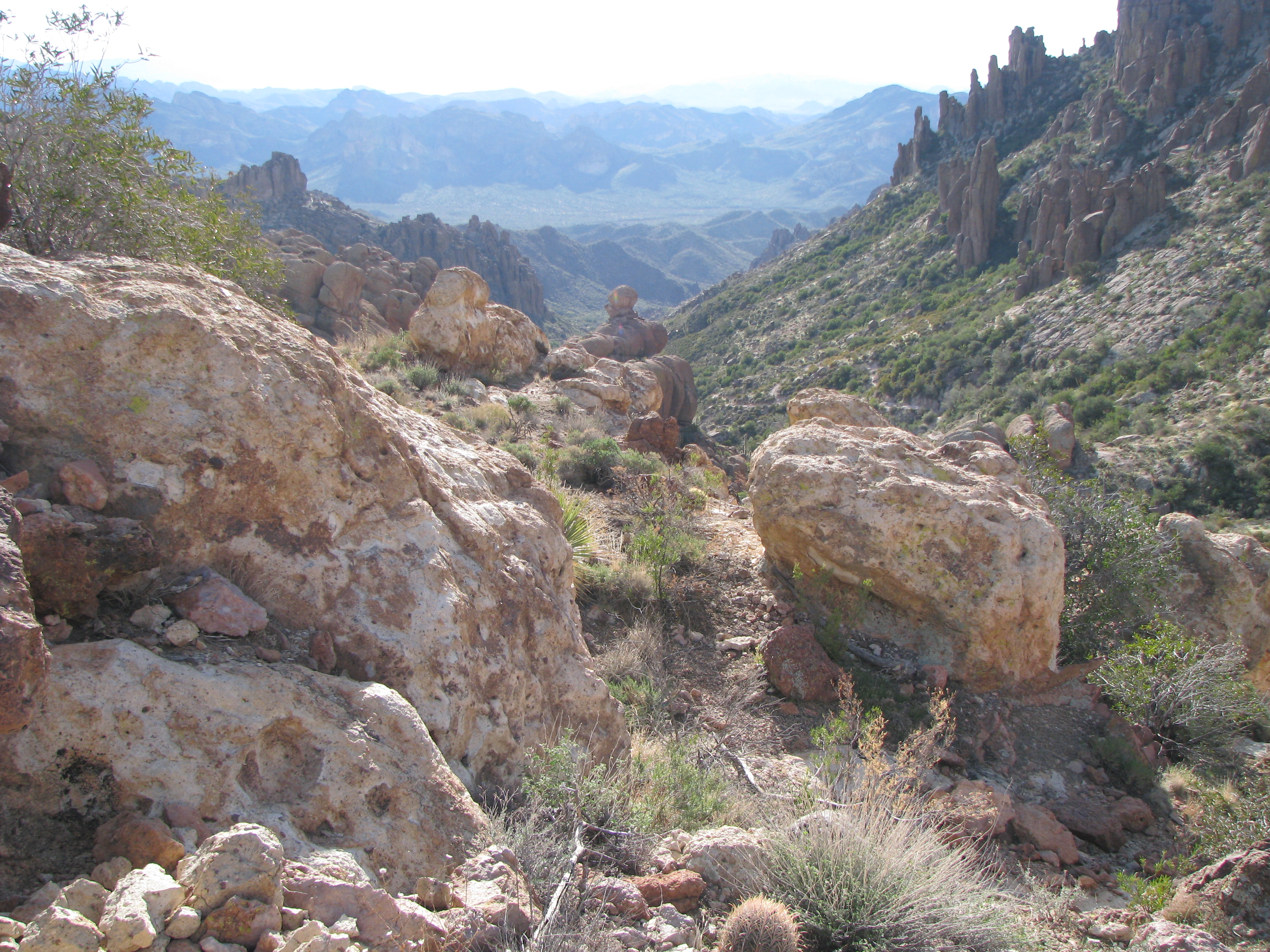
As you ascend toward the head of the canyon, the scene changes to stately hoodoos high on each side, guarding the approaches to Fremont pass.

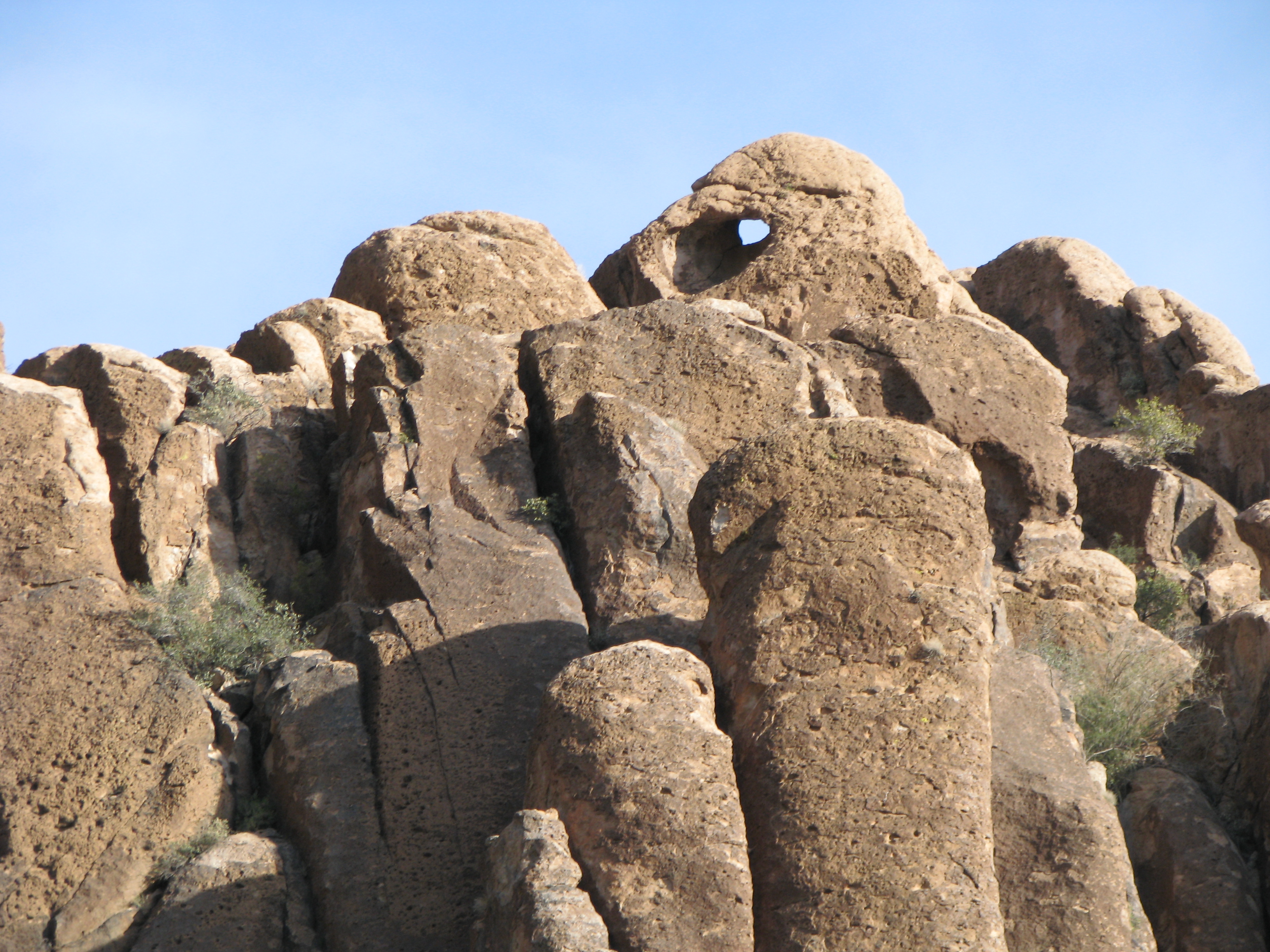
High on one of the hoodoos, a vigilant eye keeps watch on the trail below.

I always like to look back from time to time, to see “where I’ve come from”.  Here’s a view back down the trail, just before cresting Fremont Pass.

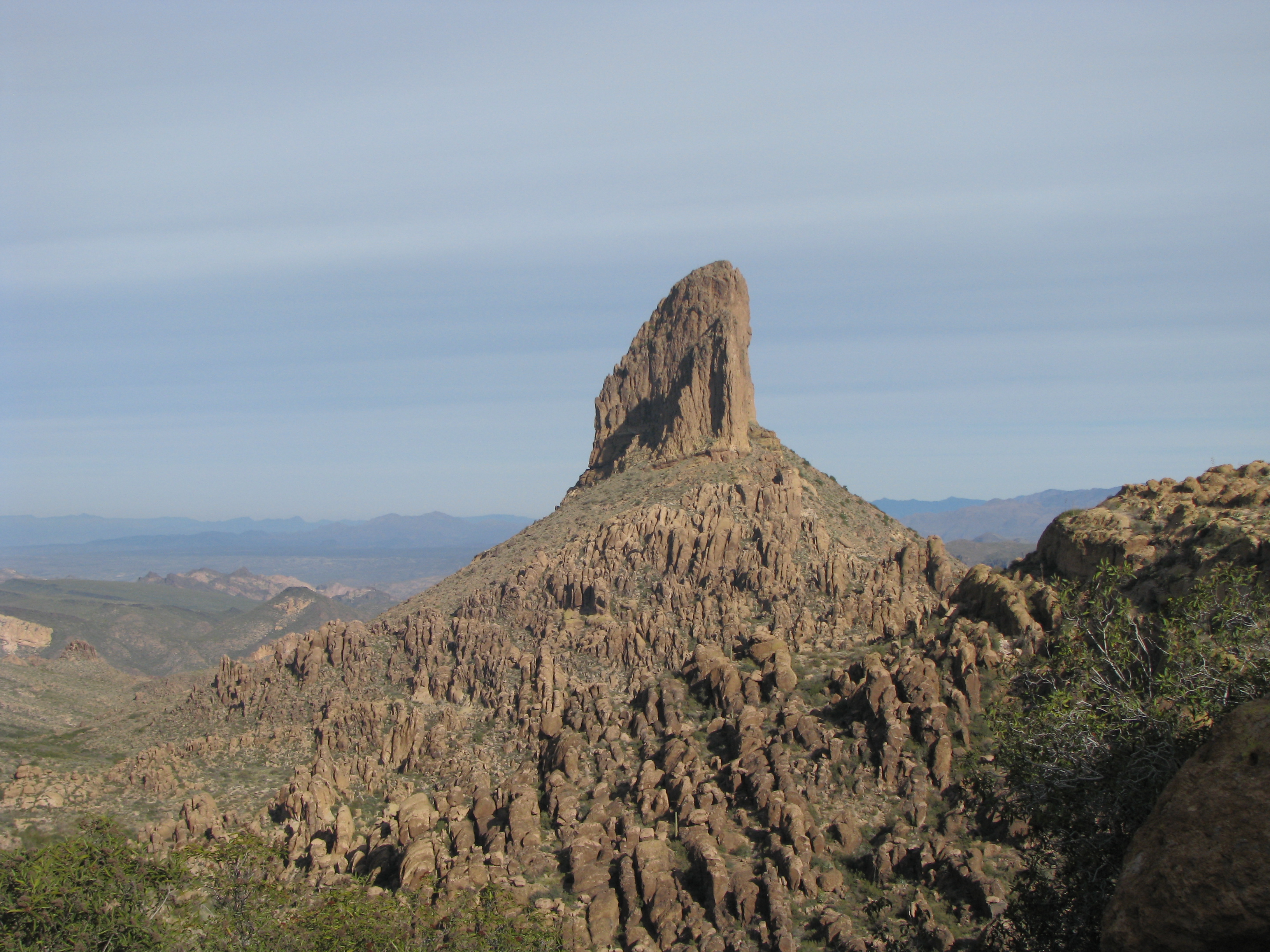
Cresting the pass, the first view of Weavers Needle never fails to be a “jaw dropper”!  It rules Boulder Canyon, and I get teased everytime I stop to gawk and get “just one more picture”!

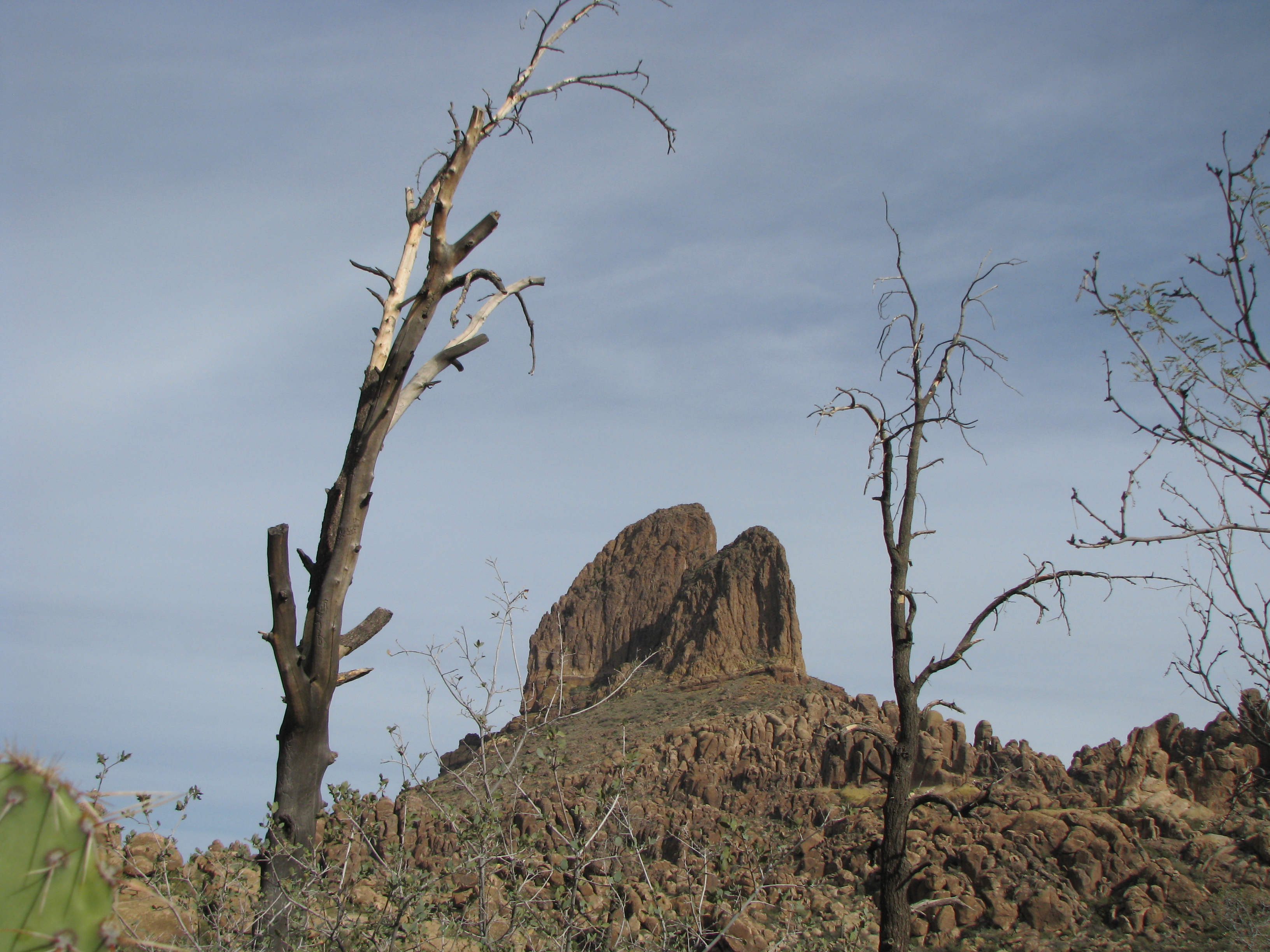
Couldn’t resist this shot, taken further down canyon, of the needle framed by two burned trees.

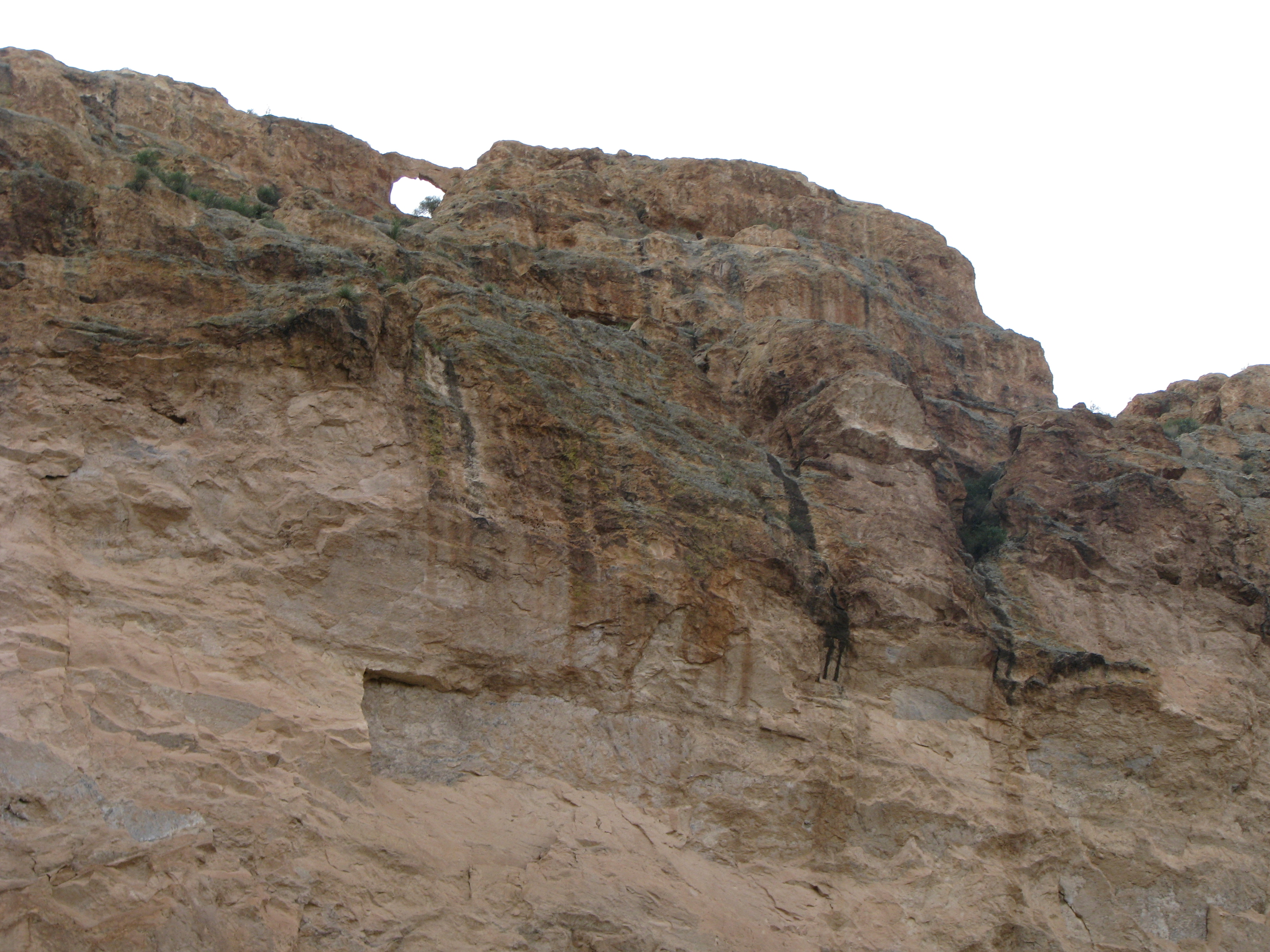
The rest of the hike is pretty routine (if the Superstition range is ever “routine”) except for this view of Aylors Arch, high on Palamino Mountain.

Posted in Arizona hiking | 3 Comments

Horse Mesa Dam – Grand Canyon of the Superstitions


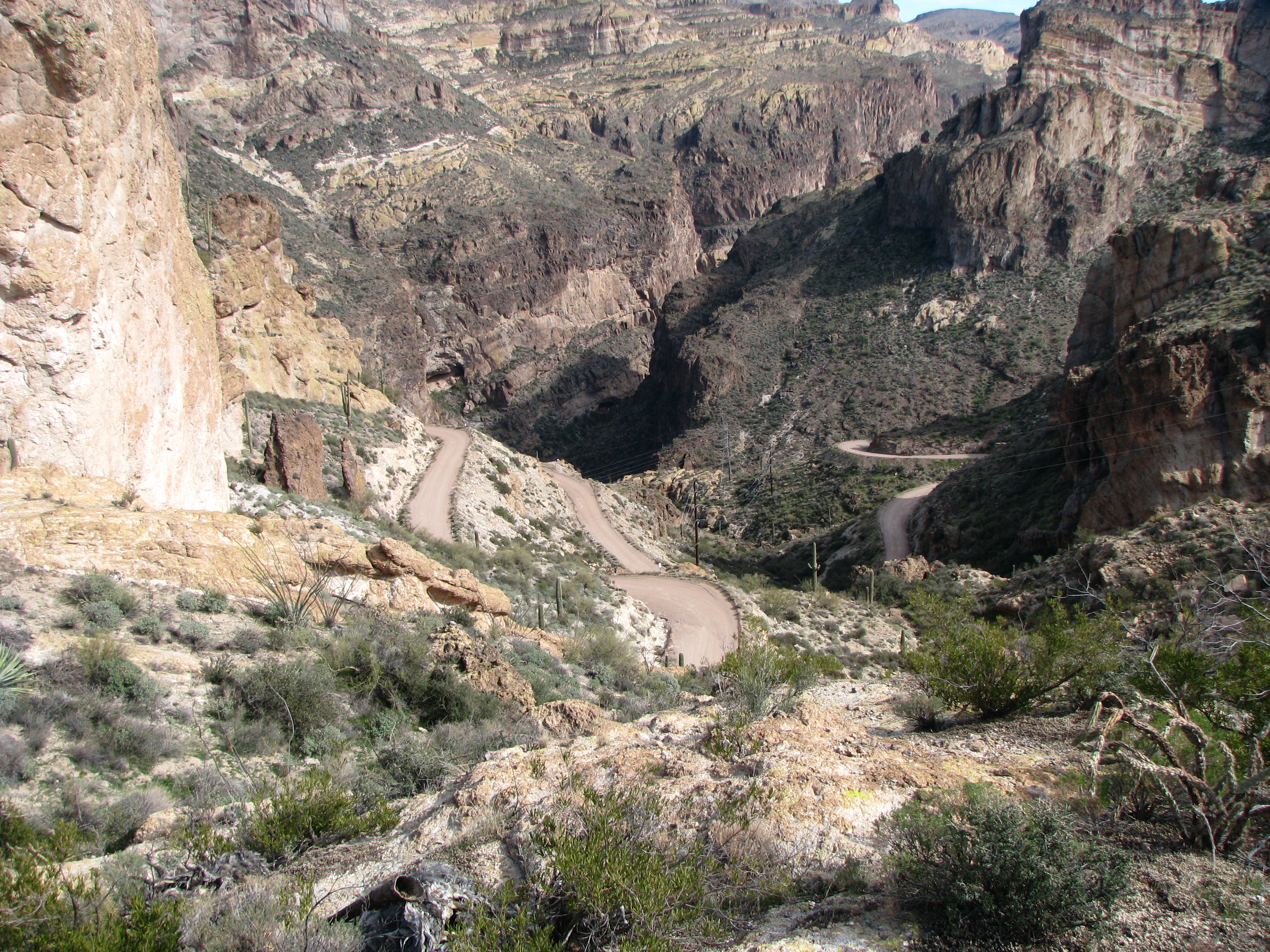
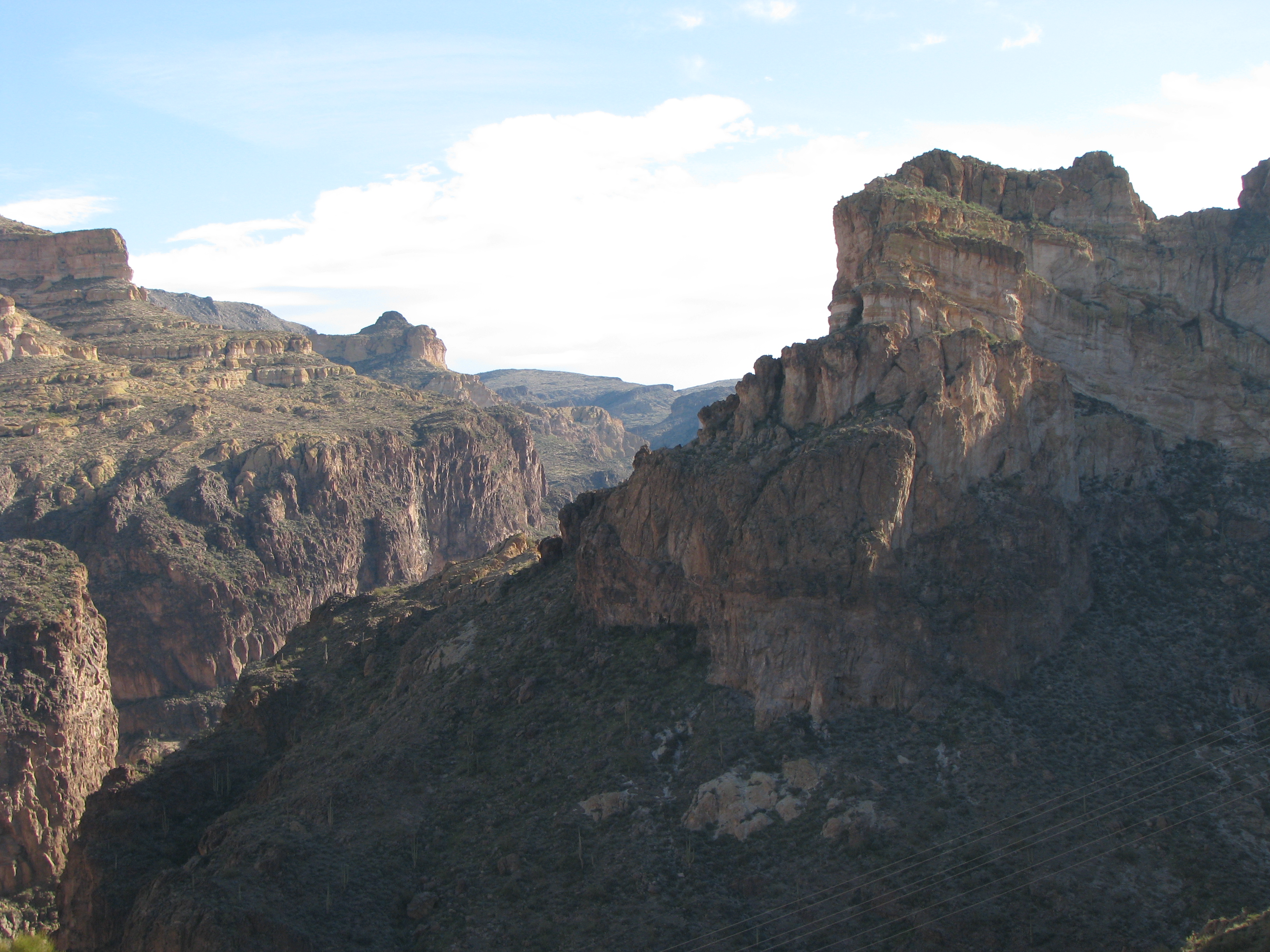
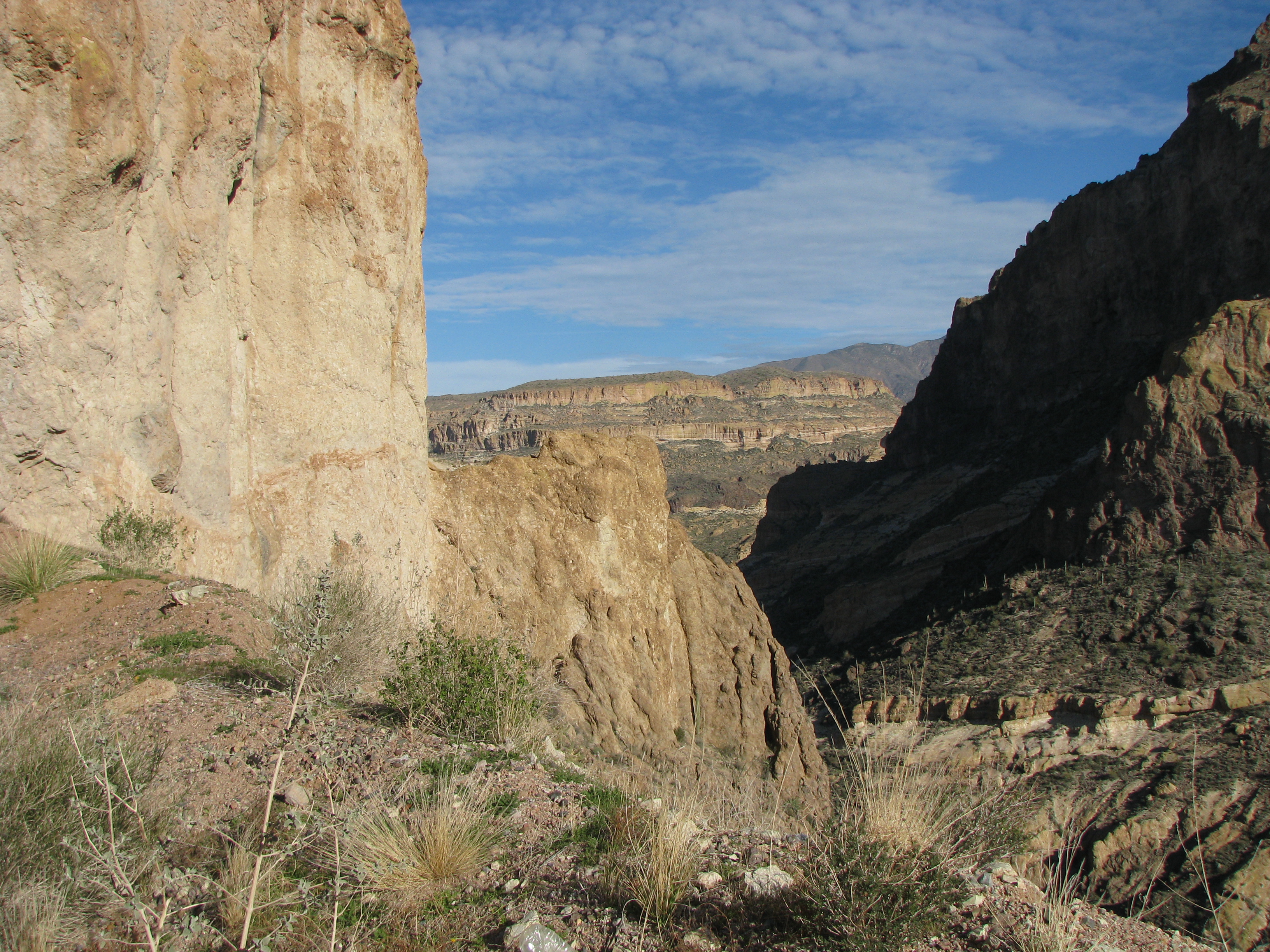
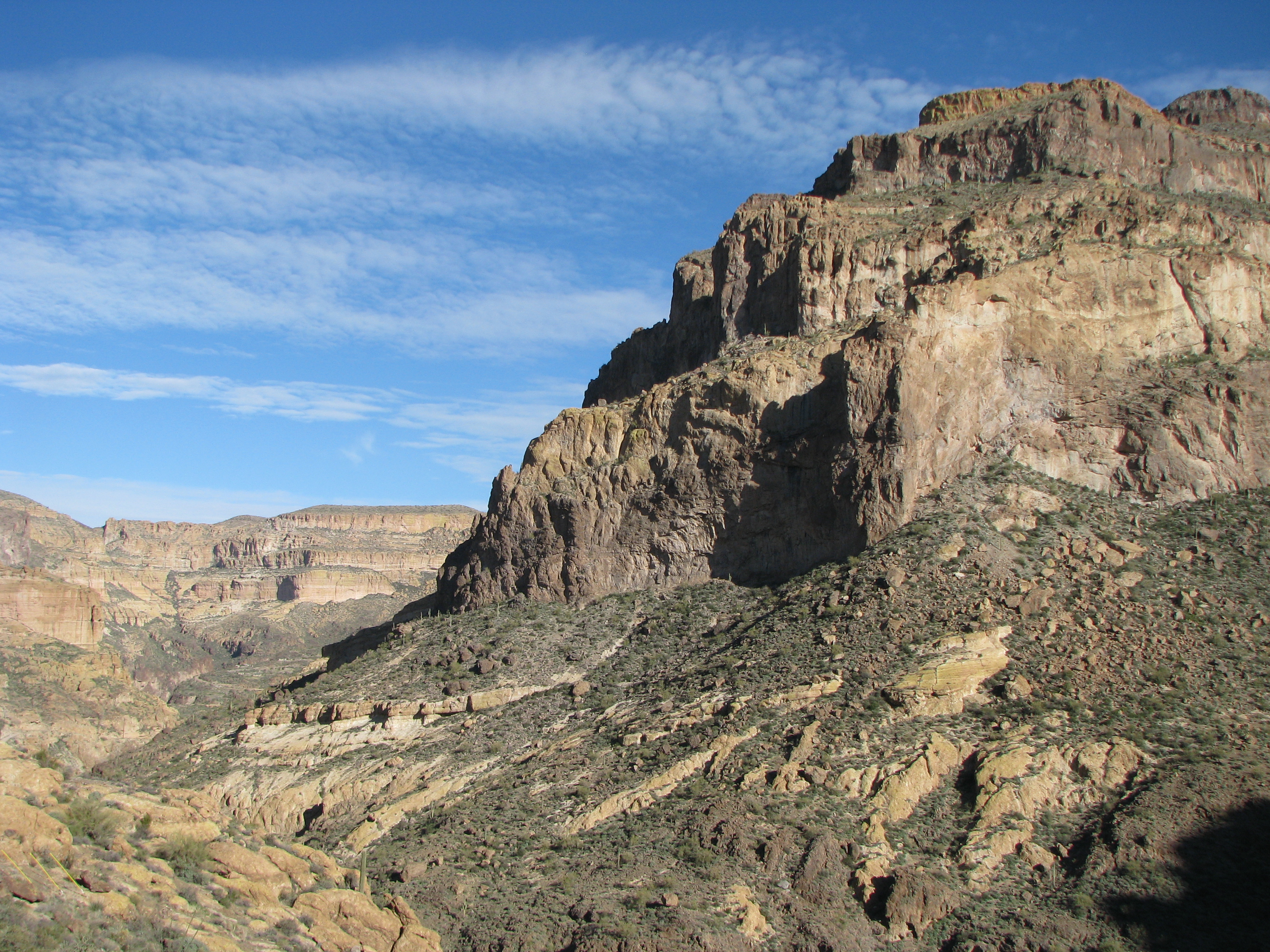
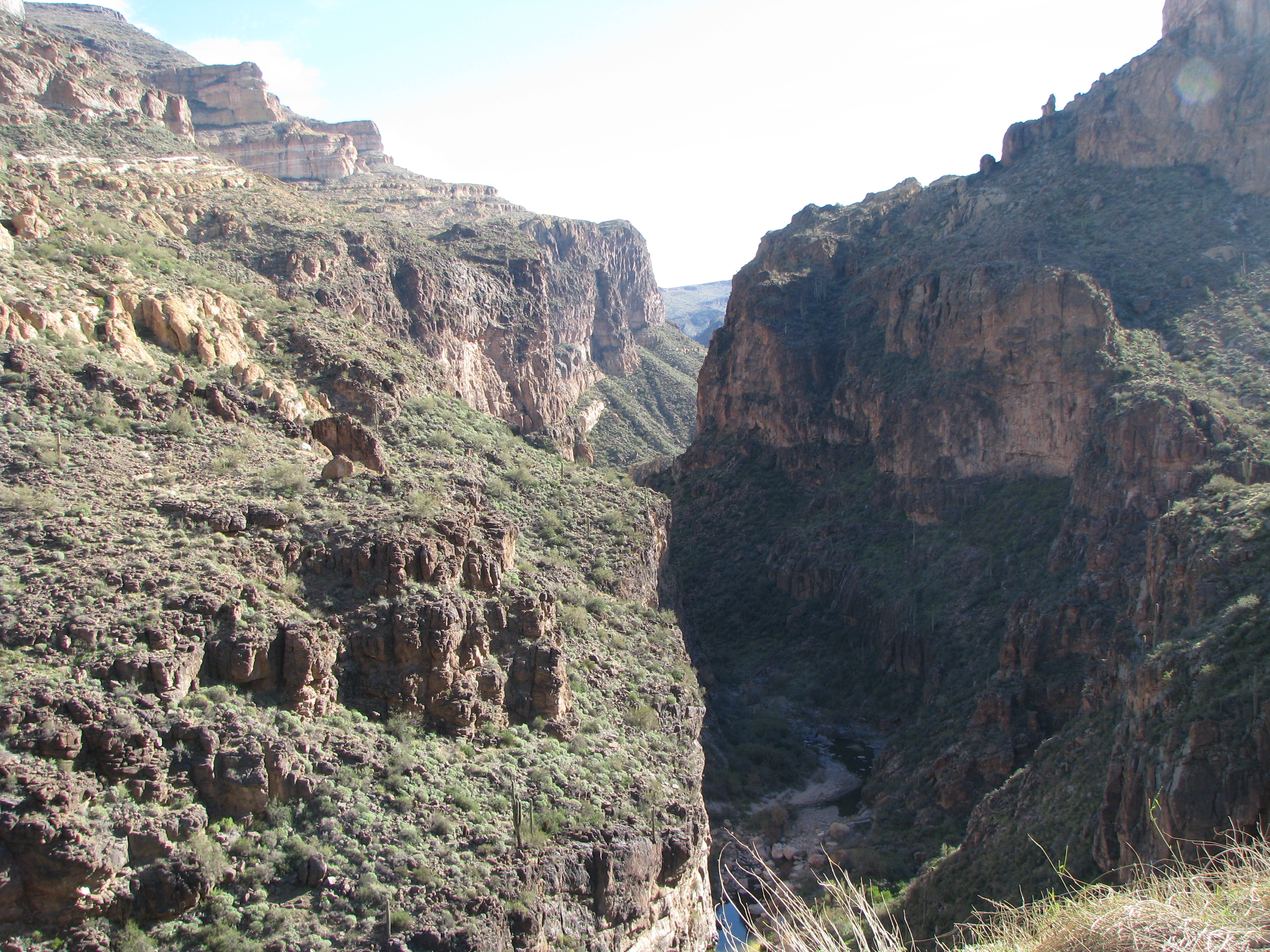
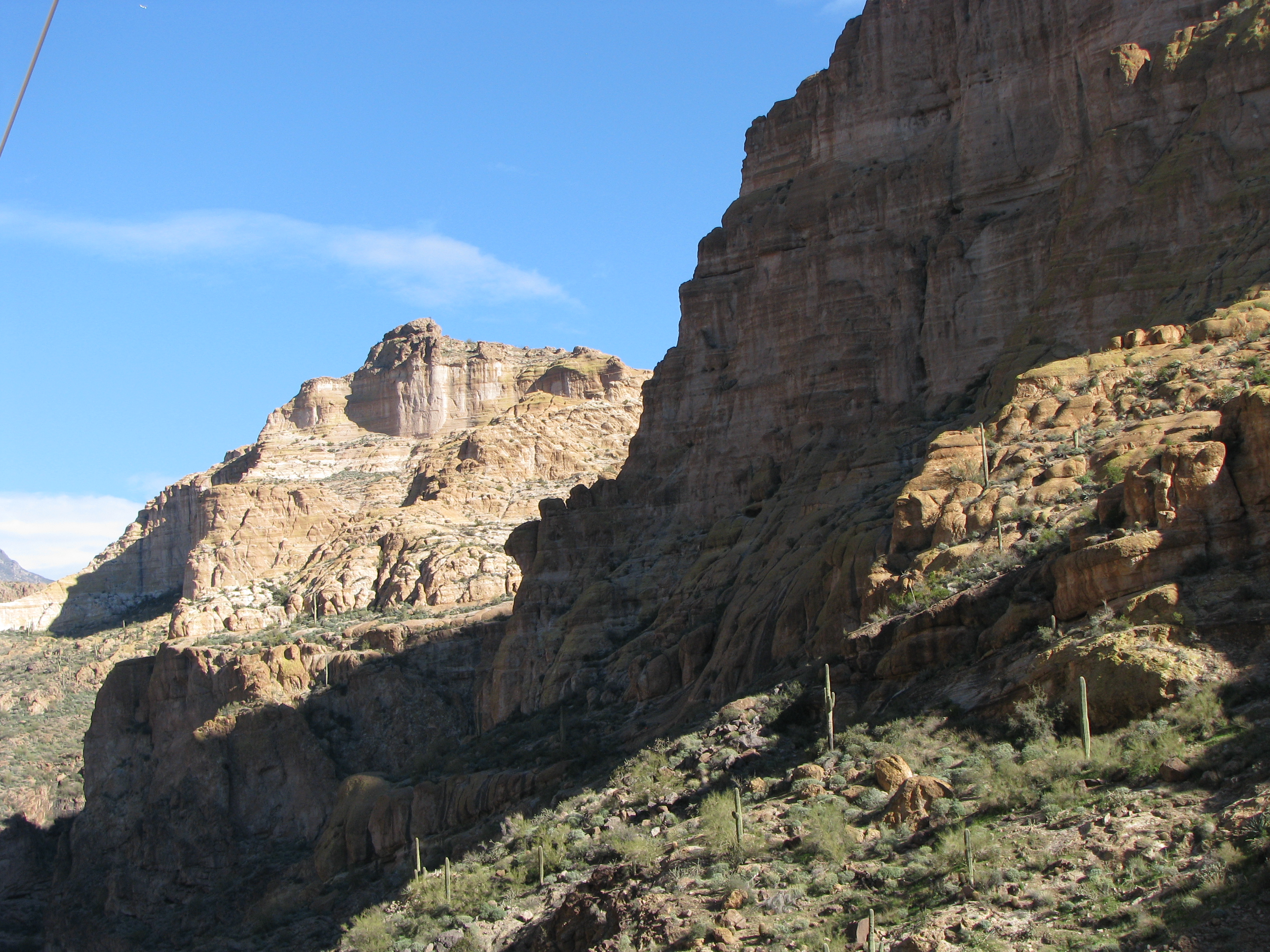
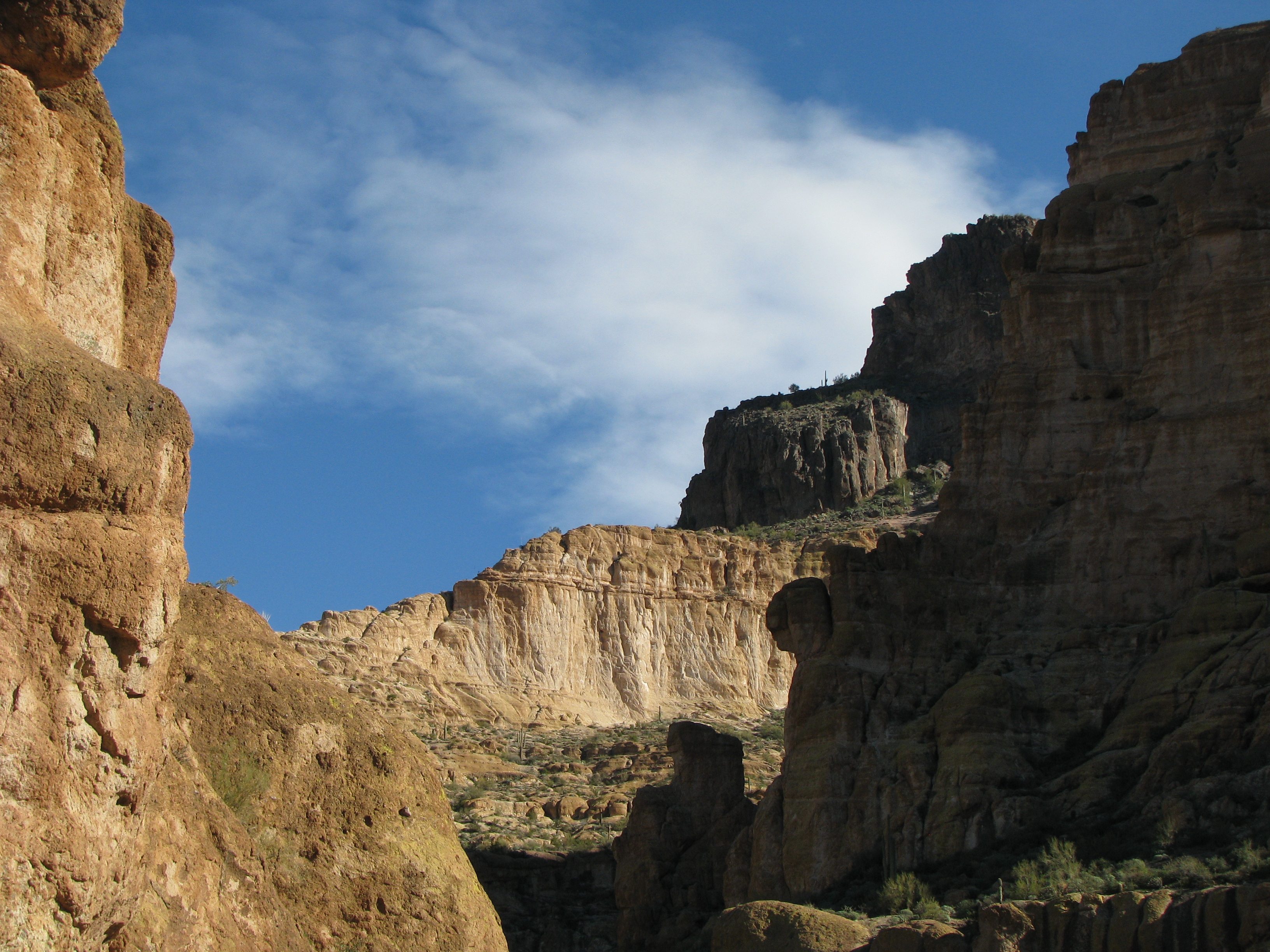
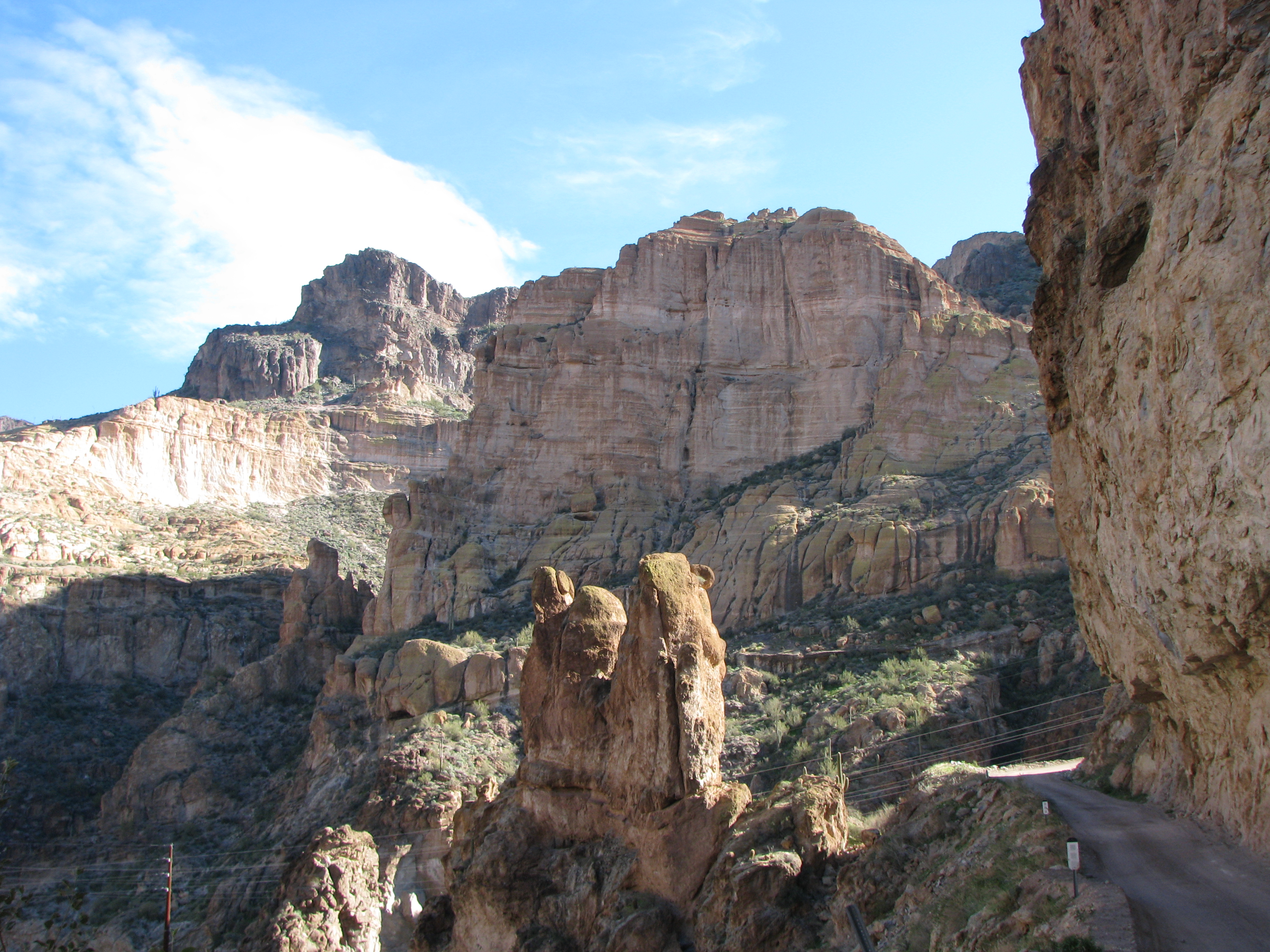
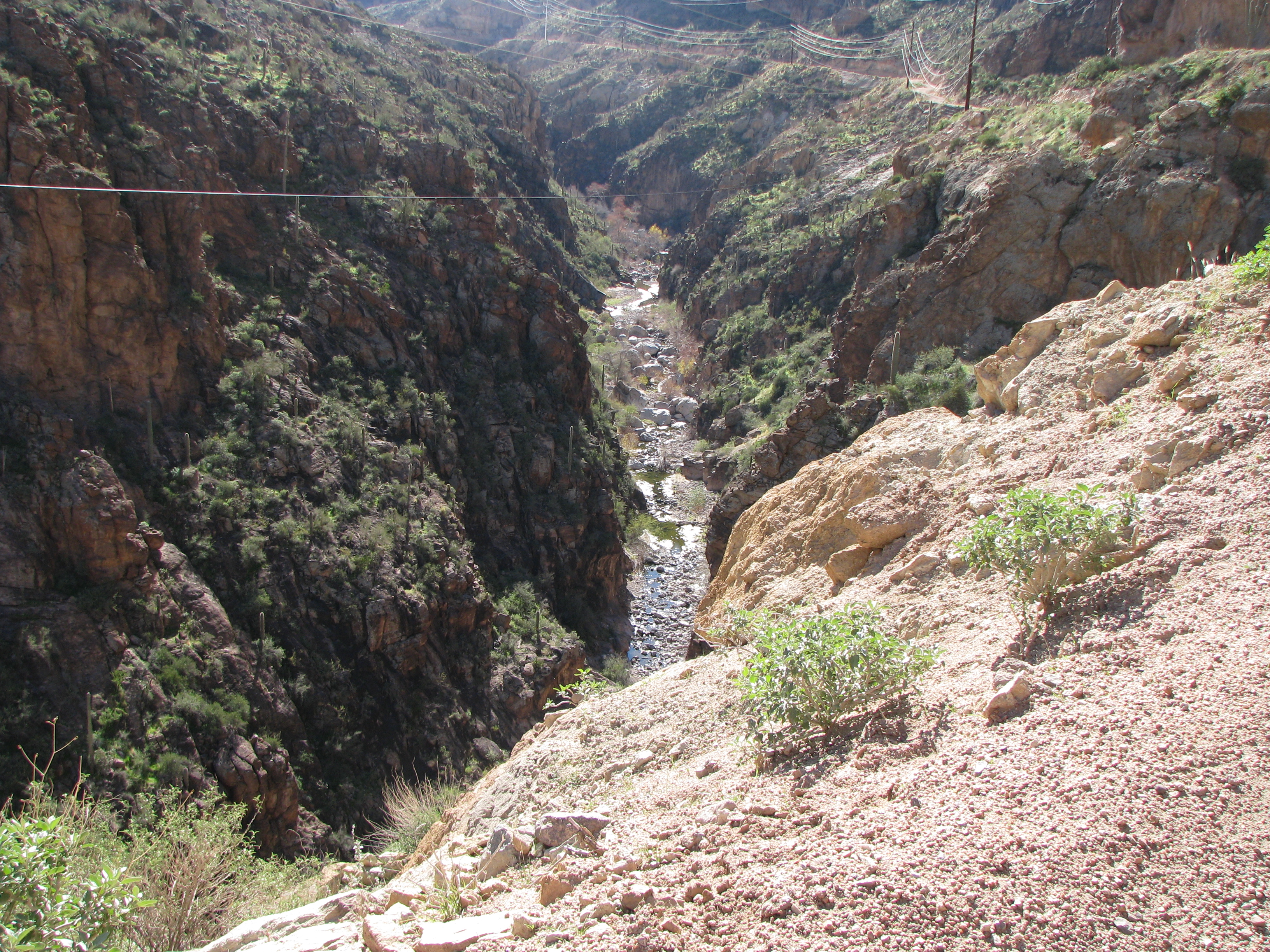
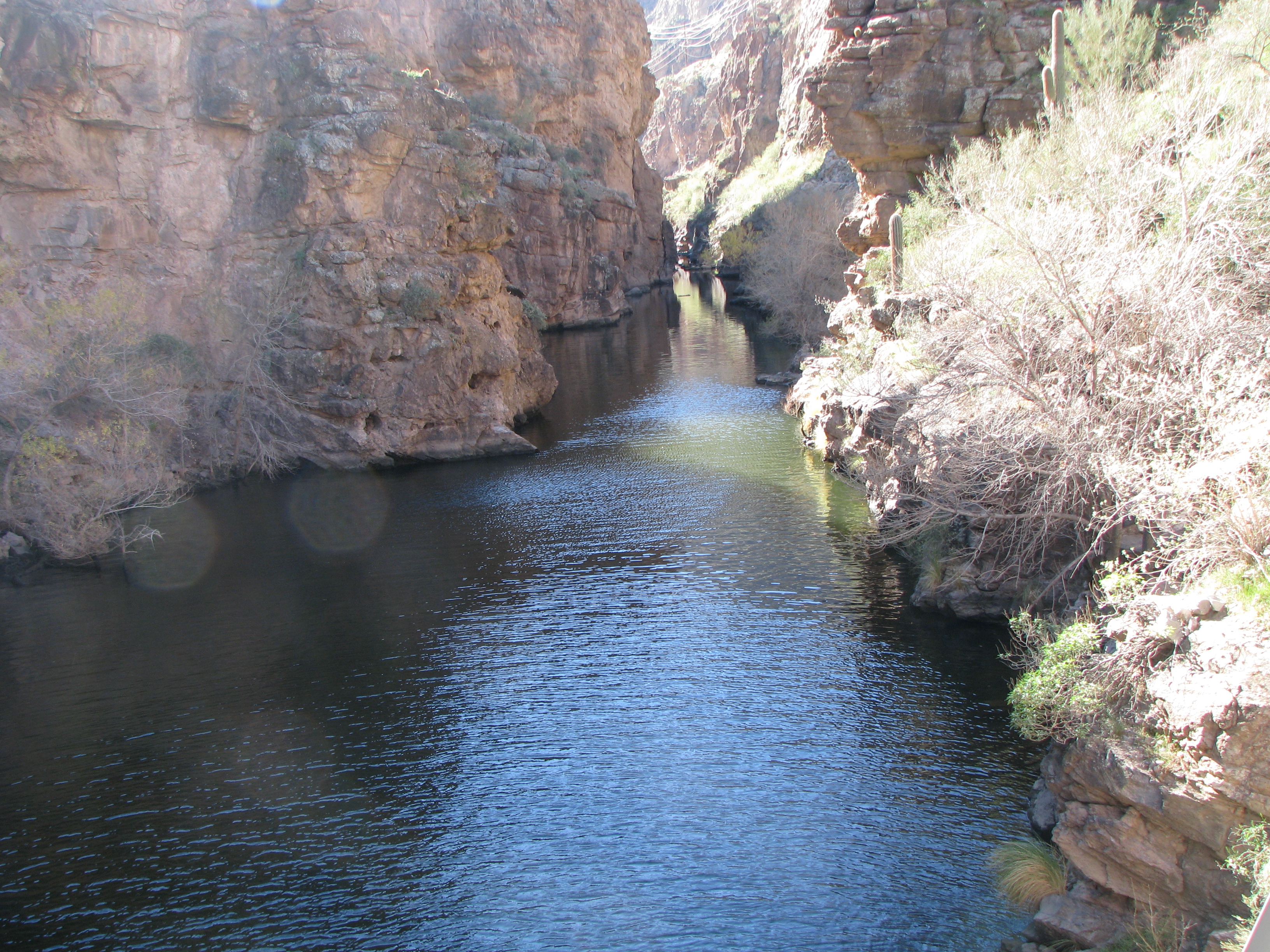
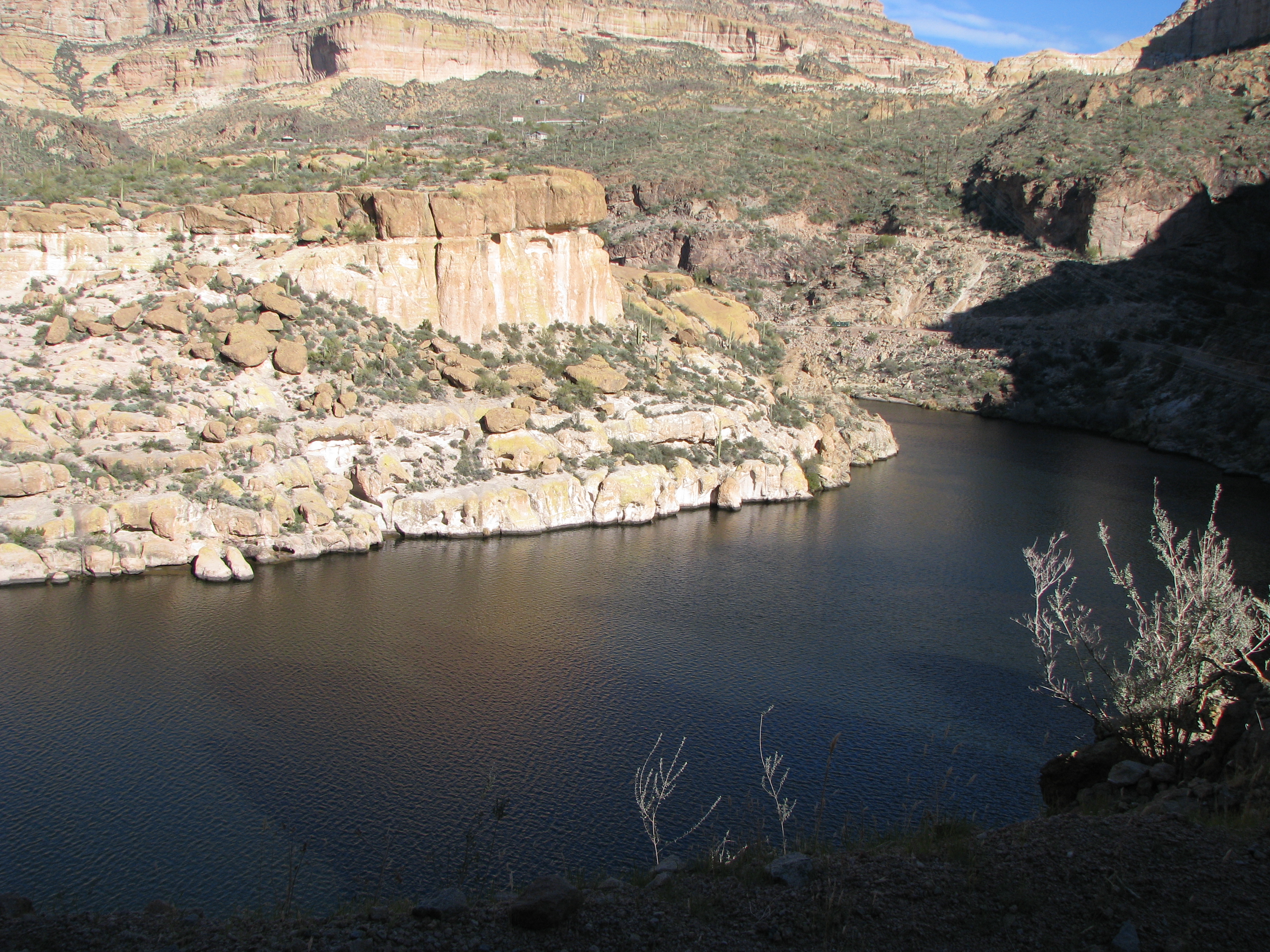
Today 4 of us hiked down to the Horse Mesa dam area, through Fish Creek Canyon which is also known as the “Grand Canyon of the Superstitions”.  The route runs on Forest Road 80, about 2.5 miles each way (in and out).  Elevation loss is about 900 feet which you need to regain on the hike out.

To reach the “trailhead” take AZ88 (Apache Trail) out from Apache Junction.  About 4 miles after you cross the “ford” at Tortilla Flats you’ll find FR80 on your left.  Follow FR80 2 or 3 miles until you reach a gate. (This is a good road, easily negotiable in your uncles Buick sedan.) Here’s where you leave your vehicle.  There’s parking for 6 or 8 vehicles.  You’re now at the “top” of the trail.

Continue afoot down FR80.

The hike is on a well maintained road which services the Horse Mesa dam on the Salt River.  The dam serves two purposes.  It forms the reservoir called Apache Lake, and is also a hydroelectric dam providing power to Phoenix about 60 miles away.  For security reasons, hikers are not allowed to approach the dam, but the hike does take you down to the river level.

First you’ll find yourself in a steep series of switchbacks stretching about 3/4-mile.

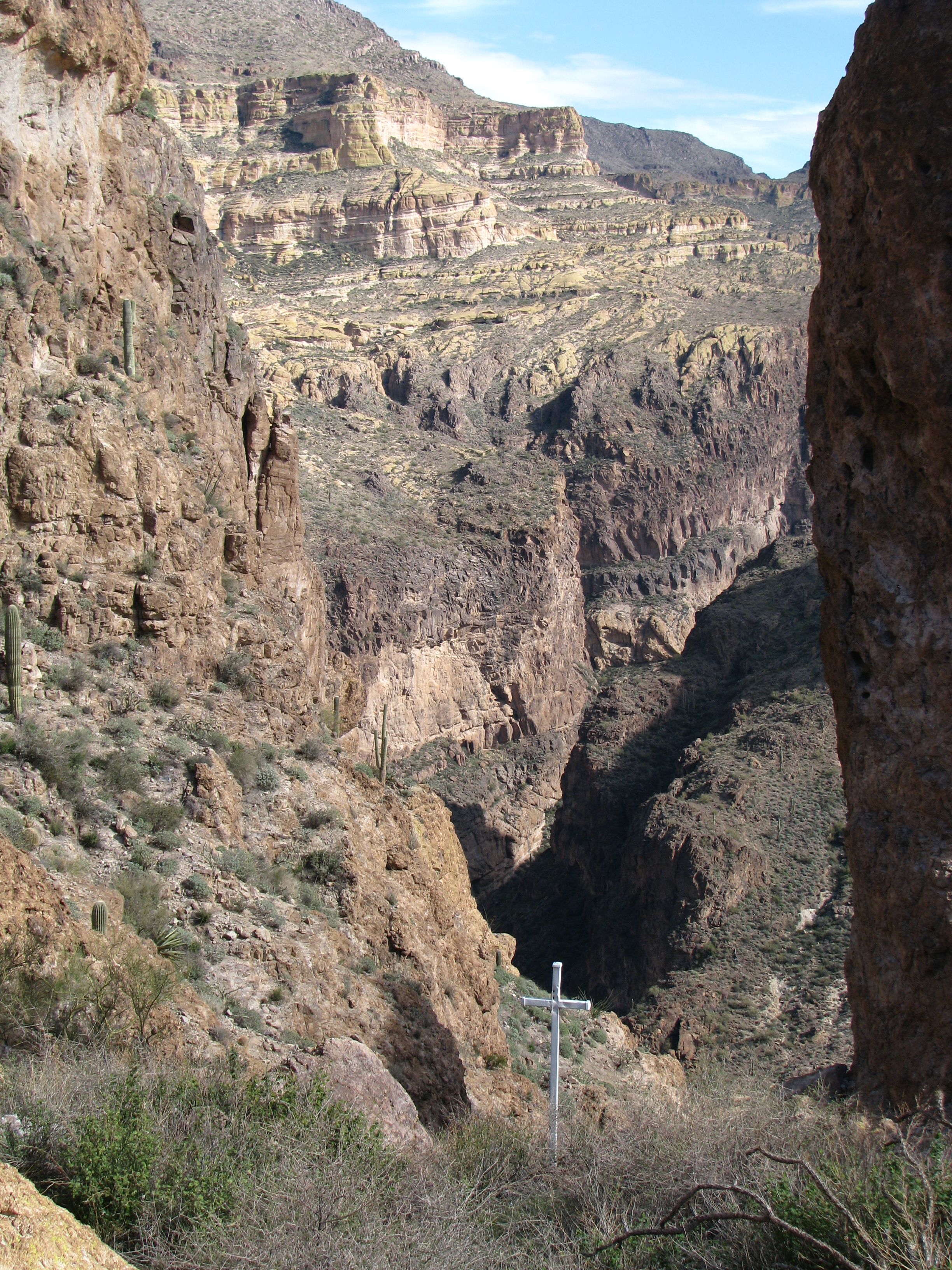
You’re immediately immersed in an awesome deep canyon environment, about 1,500 feet deep from the cliffs above you to the bed of Fish Creek hidden far below you at this point.

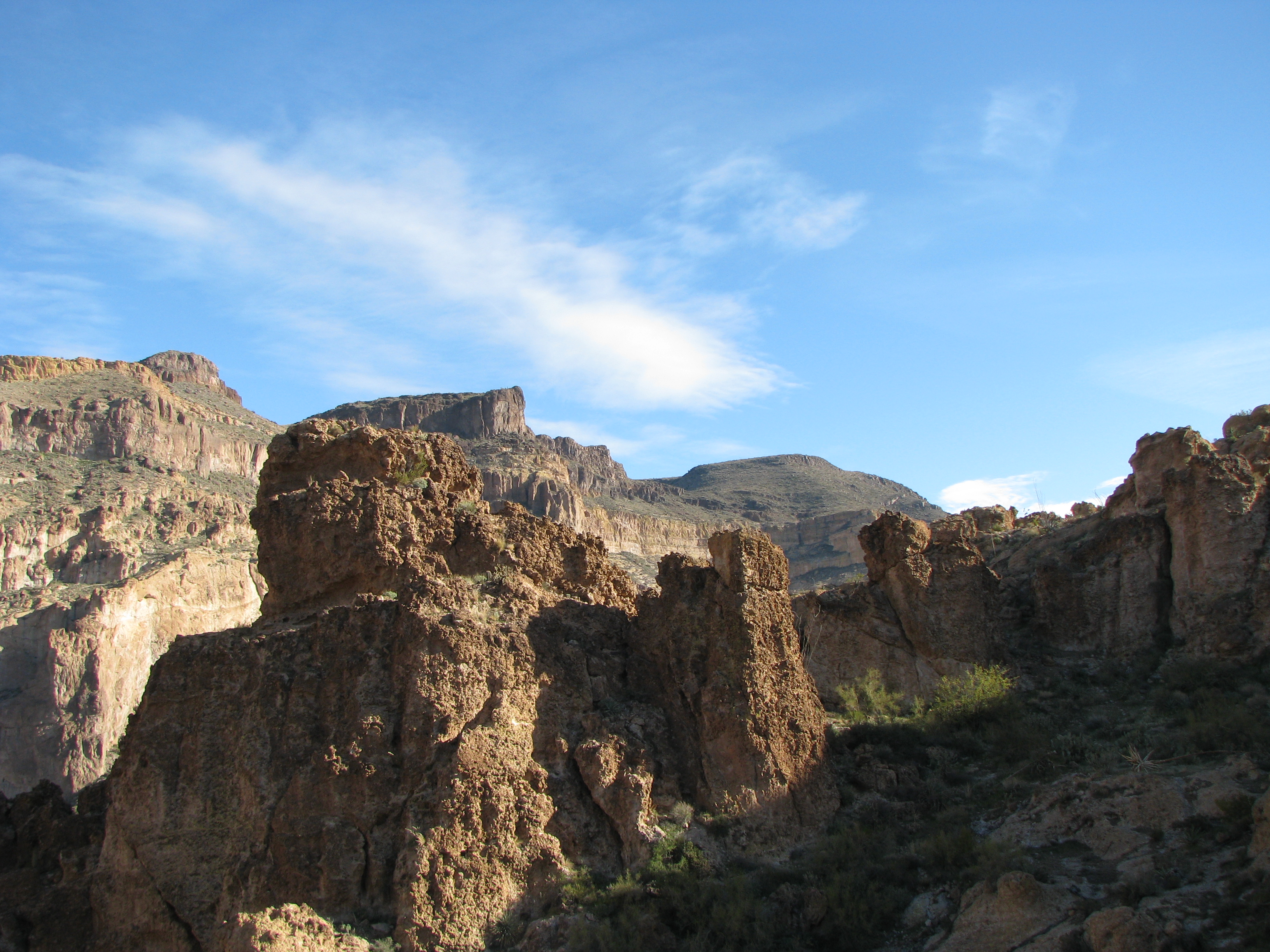
I’ll shut up for a while, and just show you some of the views on the way down.

The “turn around and go home” point of this hike is the bottom of the canyon where Fish Creek joins the Salt River in Canyon Lake.

Hope you enjoyed the walk.


Posted in Arizona hiking | 20 Comments

Sunrise Summit


Today (Friday the 13th) we did a route new to our group, a hike to the summit of Sunrise Peak.  This peak is located in northeast Scottsdale in the city-owned “Sonoran Preserve”.  The “hikingaz” website lists the accumulated gain to the summit as 1590 feet.  I think it’s somewhat less than that, perhaps 1200 feet, or maybe that 1590 is from a different trailhead.

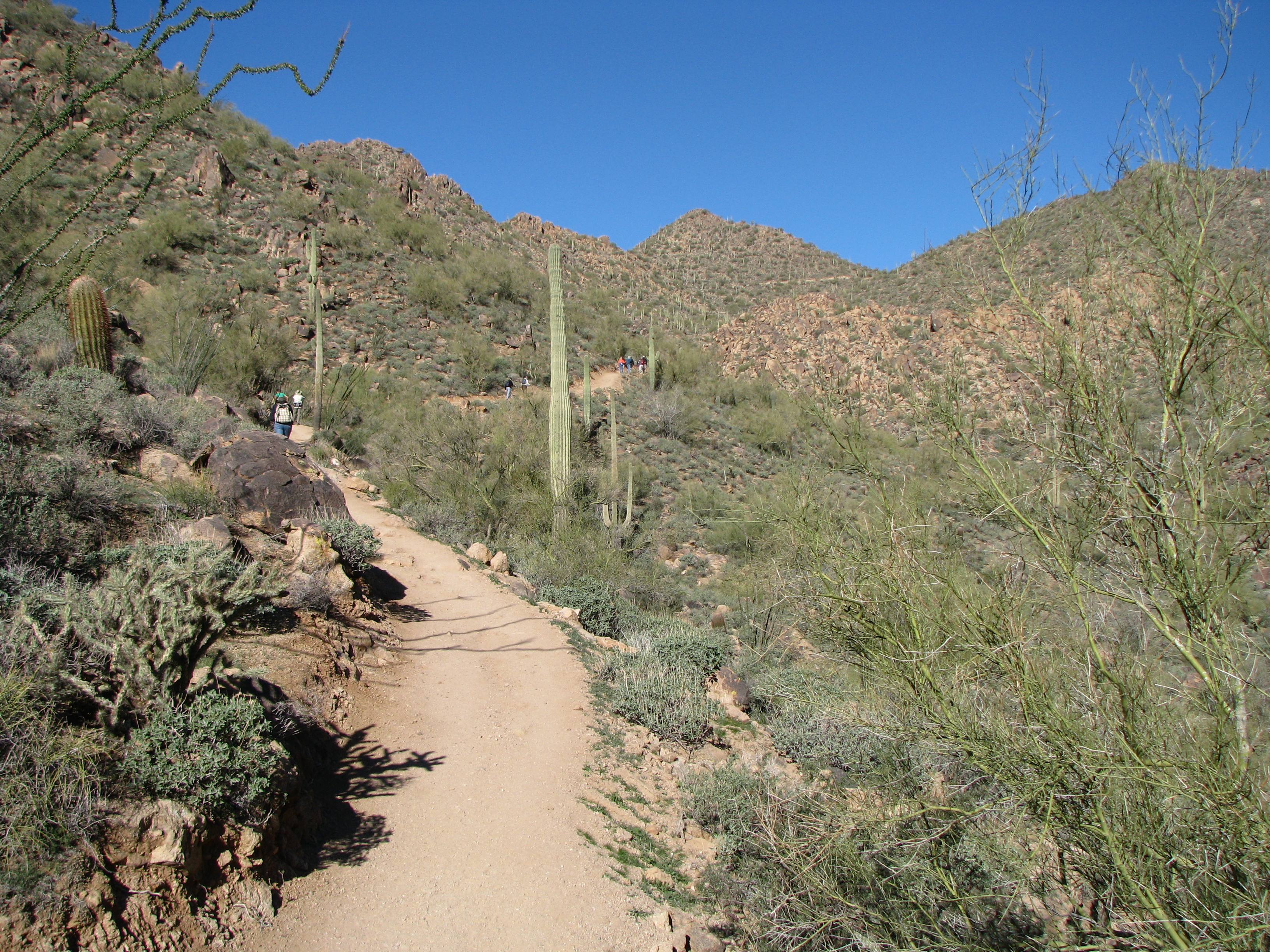
In any case, it qualifies as a Climb, roughly equivalent to Fremont Saddle in elevation gain but over about 2/3rds the distance.  But it was cool morning, with a nice breeze, so it was just a matter of pacing yourself.  As normal, I acted as the group anchor, being the last to summit.

Most of the trail was in EXCELLENT maintenance with good footing and well planned routing so the grade was not extreme.  Not extreme, but relentless!

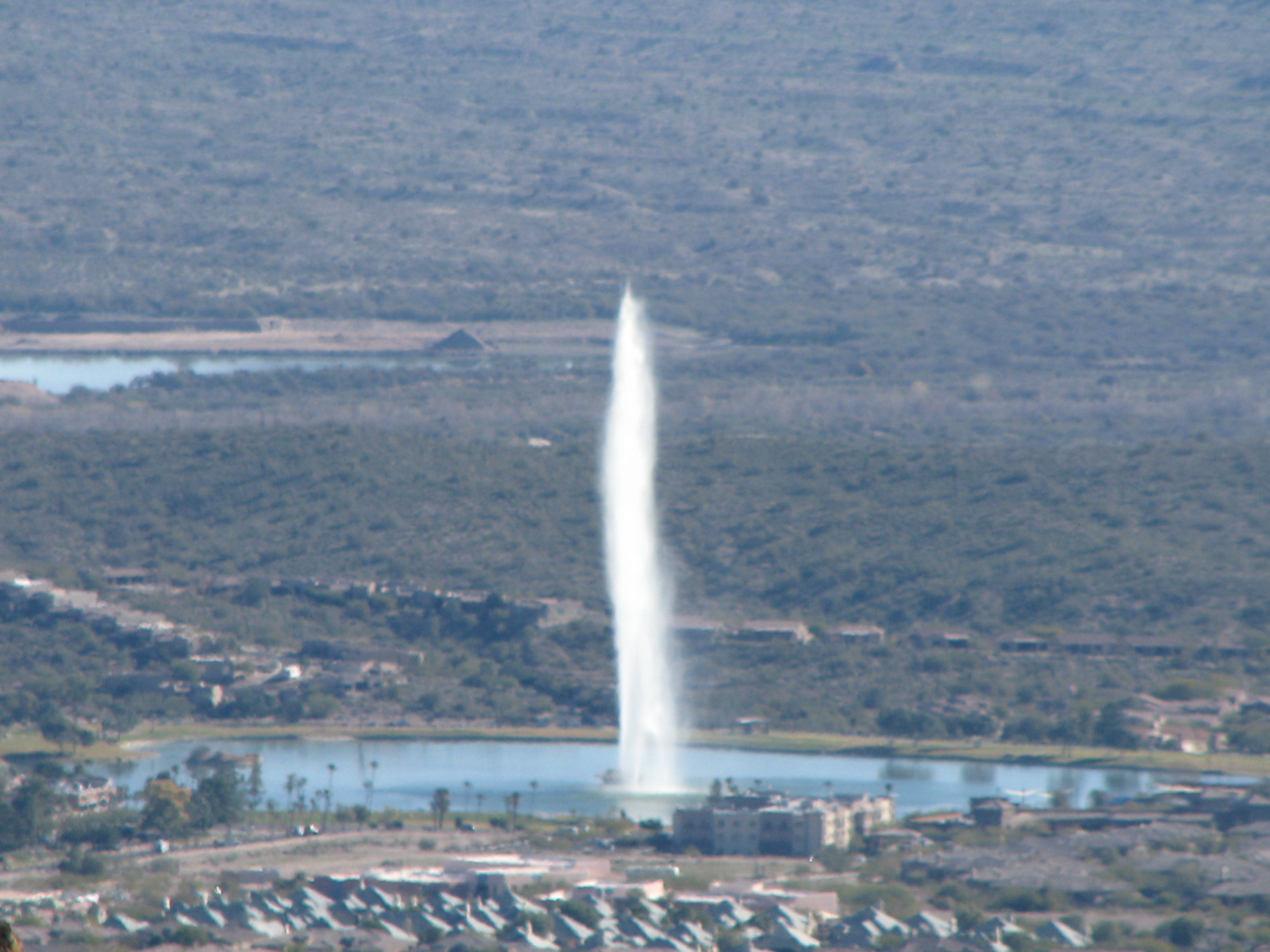
Along the way you get a lot of views of Scottsdale to the south and Fountain hills somewhat more distant in the north.  Here’s a llong-zoom shot from about 5 miles away of the famous fountain from which the city gets its name.  The fountain rises some 250 feet skyward, and is billed as the 2nd tallest fountain in the world.


The trail “crests” at a saddle between two summits, and this can be a good stopping point, then turn back.  To the south of this saddle there is a quarter-mile spur which takes you up to the rocky summit.  Here the going gets slower — still a decent trail sometimes rocky and “clamber-ry”, but pretty stiff grades and some “Mabel, don’t look down” spots, along with some great overlook spots.

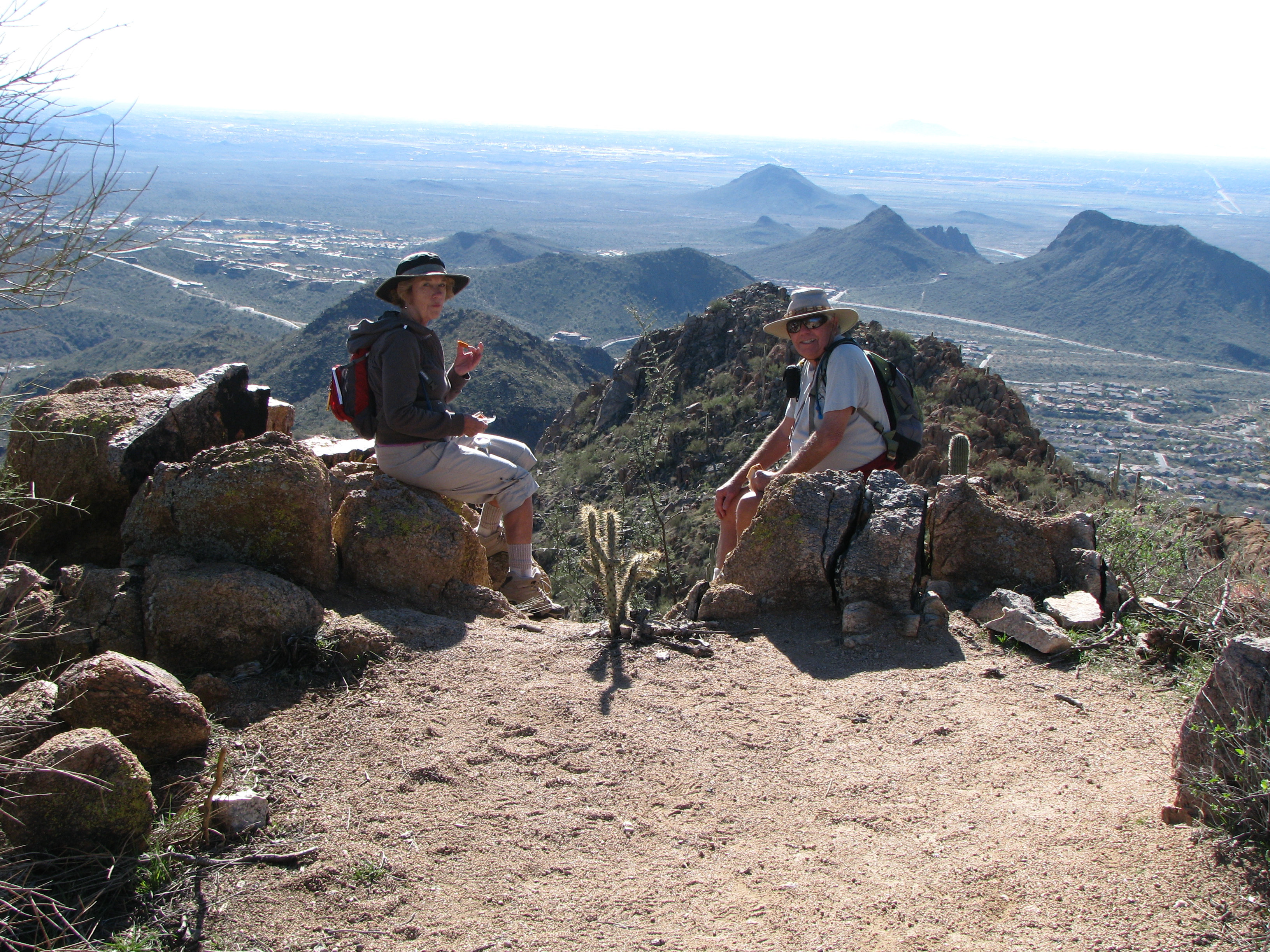
Where did YOU eat lunch today?

All your work pays off at the summit.  Enjoy the views!

Posted in Arizona hiking | Leave a comment